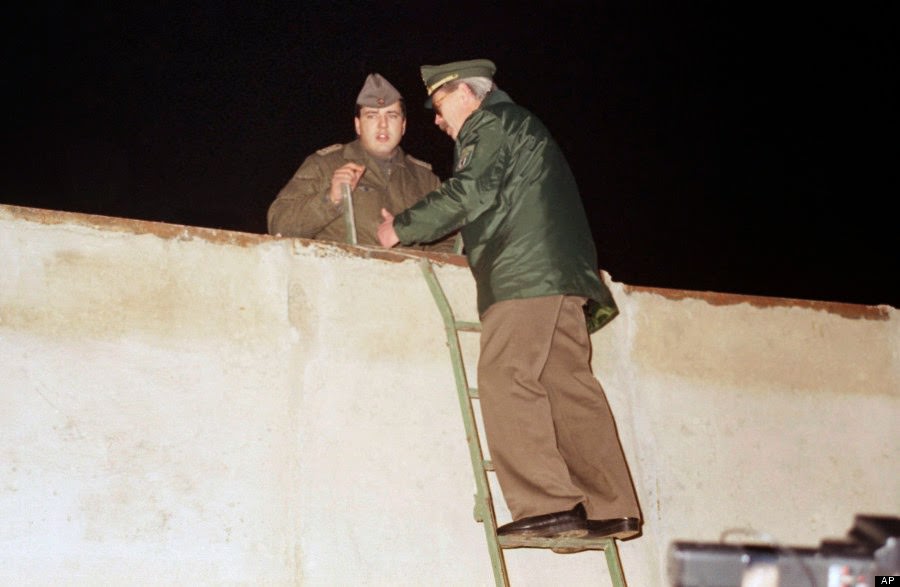
Under the harsh night sky on Bernauer Strasse, two uniformed men climb separate ladders to meet at the top of the Berlin Wall, turning a notorious barrier into an improvised conversation point. A West Berlin policeman stands to the right, facing an East German border guard as they lean in over the concrete edge, close enough to speak but still divided by the structure beneath them. The scene is quiet yet charged, suggesting how quickly the Cold War’s rigid routines were being replaced by uncertain, human-scale negotiation.
Seen in November 1989, the moment carries the atmosphere of transition: authority still present, but no longer absolute. Their body language—careful footing on the rungs, hands braced on the wall, attention fixed on each other—captures the tension of a border that had begun to soften without fully disappearing. Even without crowds in the frame, the ladders hint at the growing permeability of a line that once demanded distance, silence, and obedience.
For readers searching the history of the Berlin Wall’s final days, this photograph offers a stark, intimate view of change taking place in real time. Bernauer Strasse had long been emblematic of division, and here it becomes a place where communication literally rises above concrete. The image resonates beyond Berlin, speaking to the broader end of East–West confrontation and the fragile steps—sometimes quite literal—by which societies move from separation toward contact.