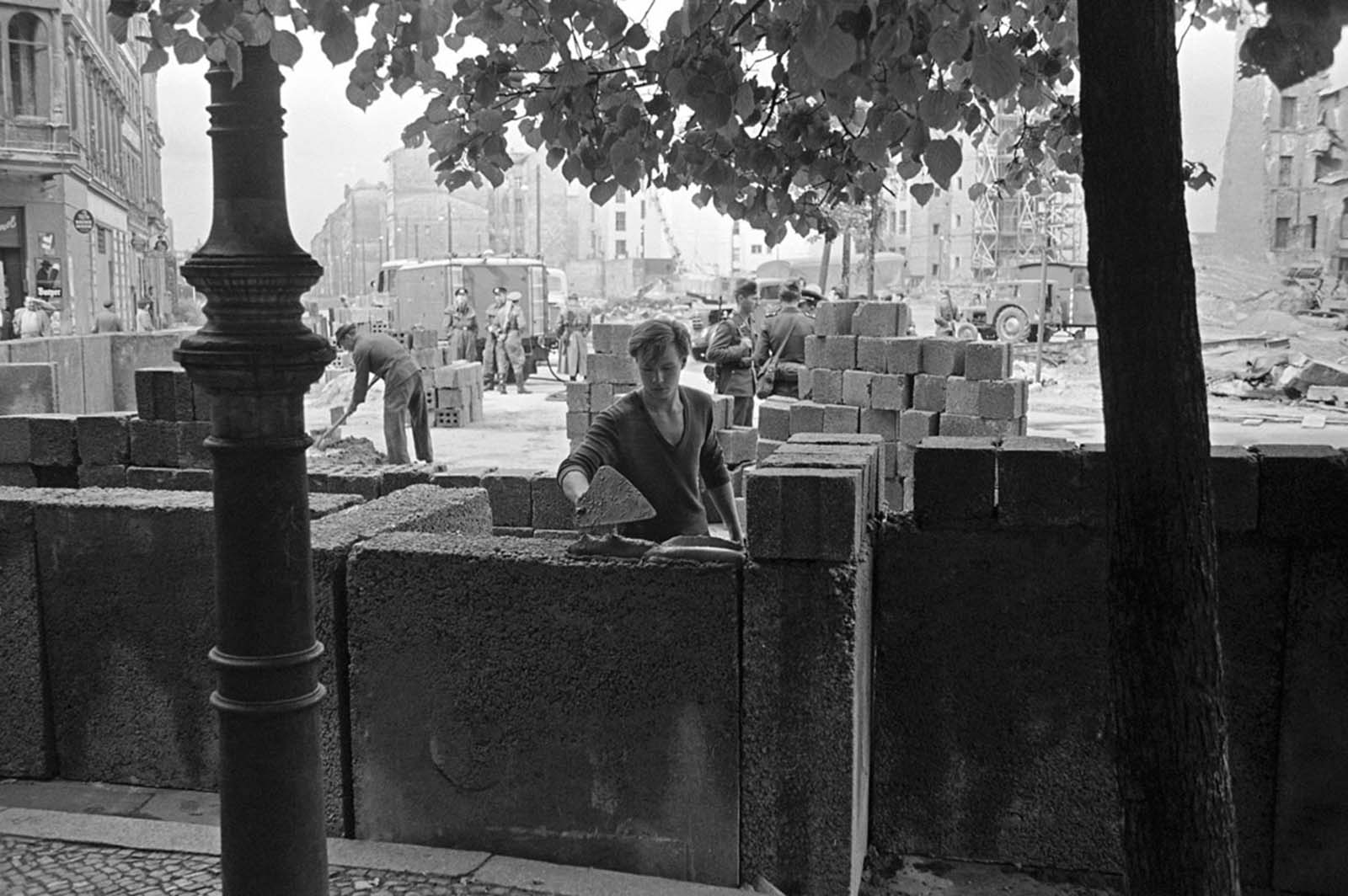
Under a canopy of leaves on a city street, a young worker leans over rough concrete blocks, spreading mortar with practiced speed as the barrier rises course by course. Around him, stacks of heavy segments form an improvised landscape of right angles, while a streetlamp and sidewalk edge remind the viewer how abruptly ordinary urban life was being interrupted. In the distance, trucks, uniformed men, and the churn of construction activity suggest a border being engineered in public view rather than hidden behind closed doors.
Dated in the title to August 18, 1961, the scene belongs to the tense early days of the Berlin Wall, when a sector border in the divided city was hardened from temporary obstacles into lasting separation. The photograph’s power lies in its plainness: masonry work, traffic held back, and watchful figures turning a thoroughfare into a checkpoint. Knowing that barbed wire would later crown this concrete, the stacked blocks read less like a building project and more like the first chapters of a Cold War frontier.
What makes the moment linger is the contrast between the worker’s youth and the permanence implied by the materials, as if the future were being set in place by hand. The title’s “Civil Wars” echoes here not as battlefield drama but as a civic rupture—neighbors divided, routines redirected, and a city’s map rewritten by force and policy. For readers searching Berlin Wall history, East Berlin 1961, or sector border construction, this image offers a grounded, street-level view of how separation was built one block at a time.