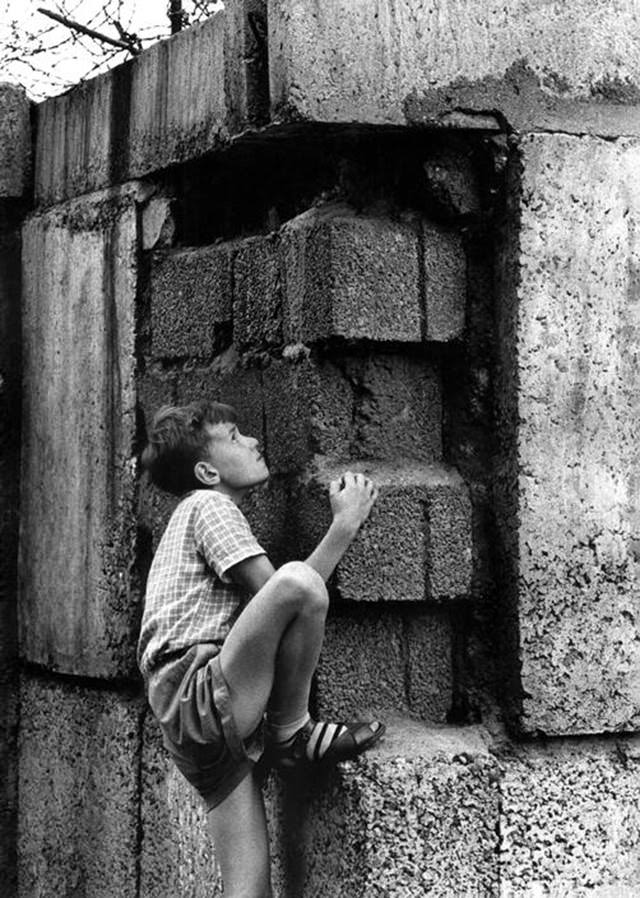
Perched against a jagged notch in the concrete, a young boy tests the Berlin Wall with bare hands and careful footing, as if it were just another obstacle in a city street. The rough blocks and crumbling edges form an improvised ladder, while his upward gaze draws attention to the sheer height and weight of the barrier overhead. Even without a wide view of the border, the wall’s texture—scarred, patched, and unforgiving—tells its own story.
On the West Berlin side, moments like this carried a mix of curiosity, bravado, and quiet defiance, especially for those too young to have chosen the division that shaped their everyday lives. The photograph doesn’t need soldiers or searchlights to communicate tension; the danger is implied by the act itself, and by the narrow pocket of space that offers a foothold. It’s a striking reminder that the Cold War was not only a geopolitical struggle but also a physical reality built into neighborhoods, routines, and childhood.
Set within the larger history of East and West Berlin, this scene underscores how the Berlin Wall functioned as both boundary and symbol—something to be feared, negotiated, and, for some, challenged. The image resonates in searches for Berlin Wall history, West Berlin life, and stories of divided Germany because it frames the era through an intimate human scale. A single child and a slab of concrete become an unforgettable snapshot of a city split in two.