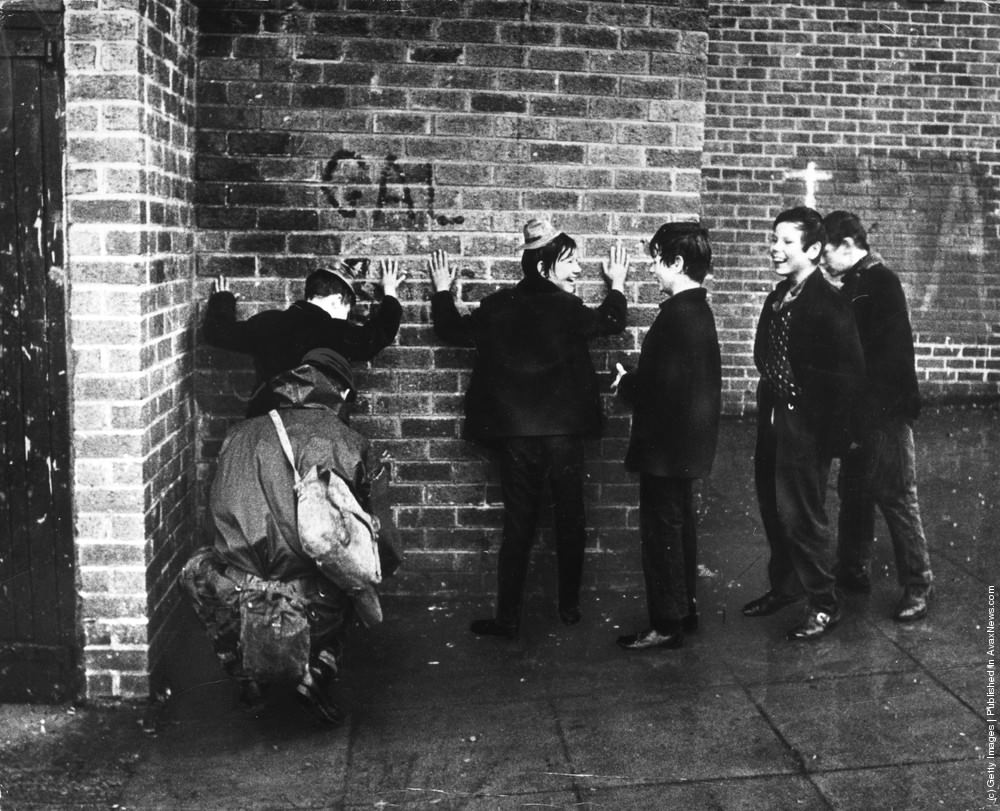
Against a brick wall in Ardoyne, Belfast, a line of schoolboys in dark uniforms is held still while a soldier crouches to search one of them, his kit and posture signalling the hard routines of street patrol. Hands are spread on the masonry, faces turned sideways, and yet laughter breaks through the tension—one boy grins broadly while another tries to stifle a giggle. Even the wall speaks, marked by rough graffiti and a small cross, quiet symbols in a neighbourhood where ordinary surfaces carried meaning.
Dated 7th December 1971, the scene sits firmly within the era of the Troubles, when stop-and-search operations became a daily fact of life and childhood and conflict collided in plain view. The camera catches the uneasy coexistence of discipline and defiance: the soldier’s methodical attention contrasts with the boys’ buoyant humour, as if joking is the only available counterweight to fear. A street corner becomes a checkpoint, and school uniforms—normally a sign of routine—read instead as vulnerability under scrutiny.
For readers interested in Northern Ireland history, Ardoyne, or civil conflict photography, this image offers a stark, intimate look at how militarisation shaped public space and private emotion. The composition is simple—wall, pavement, figures—yet it captures a complex reality: authority enacted at close range, and young people finding ways to remain themselves. In that brief moment of laughter during a search, the photograph preserves both the pressure of 1971 Belfast and the resilience that persisted within it.