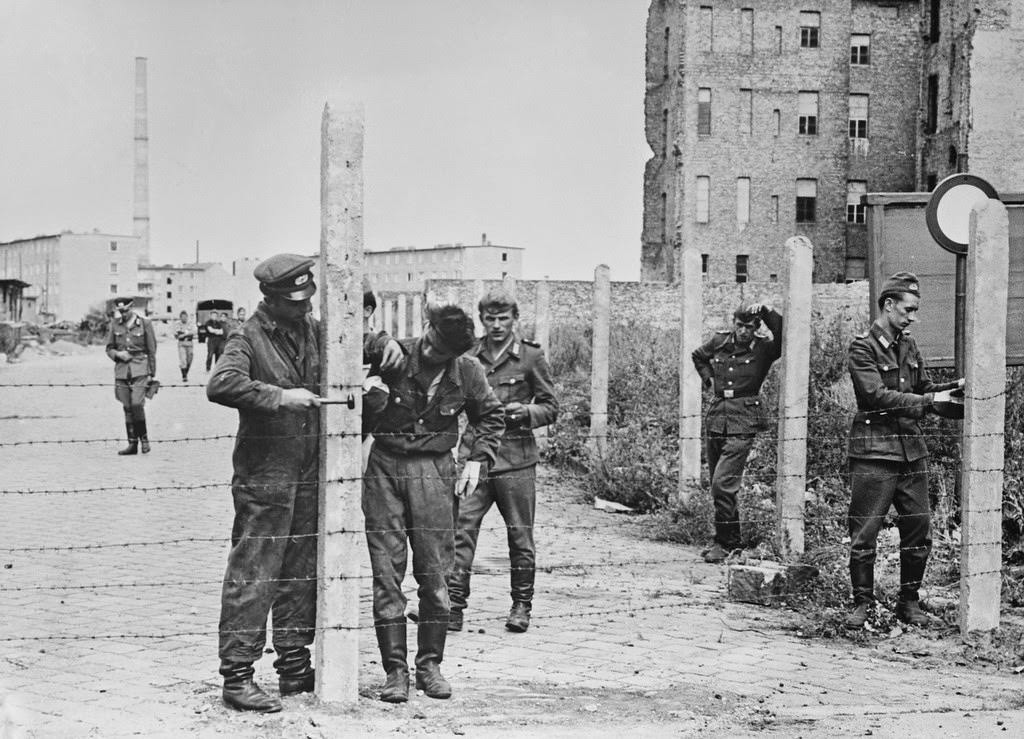
Barbed wire is being pulled taut between rough concrete posts as soldiers of the East German National People’s Army (NVA) work quickly to close off a Berlin street on 14 August 1961. The scene is plain and utilitarian—boots on cobblestones, gloved hands guiding the wire, and a stark urban backdrop of damaged masonry and empty windows that hint at the city’s unresolved scars after the war. What looks like routine fieldwork carries an unmistakable sense of urgency, as if the boundary is being created faster than anyone can fully grasp.
Along the right edge of the frame, another uniformed figure fastens the barrier with careful, repetitive motions while a few others watch, wait, or confer in the middle distance. The camera catches a moment of transition: open space becoming restricted space, a public street turning into a controlled line. Even without crowds in view, the absence itself feels telling—an everyday route transformed overnight, not by rubble or accident, but by deliberate policy made visible in wire and posts.
For readers searching Berlin Wall history, Cold War Berlin, or NVA soldiers in 1961, this photograph distills the earliest phase of a border that would harden rapidly in the days and years that followed. It reminds us that monumental geopolitical divisions often begin with simple materials and ordinary labor, executed under orders yet lived by civilians on both sides. The image stands as a quiet, unsettling record of how a city’s geography—and the lives threaded through it—can be rewritten in a single morning.