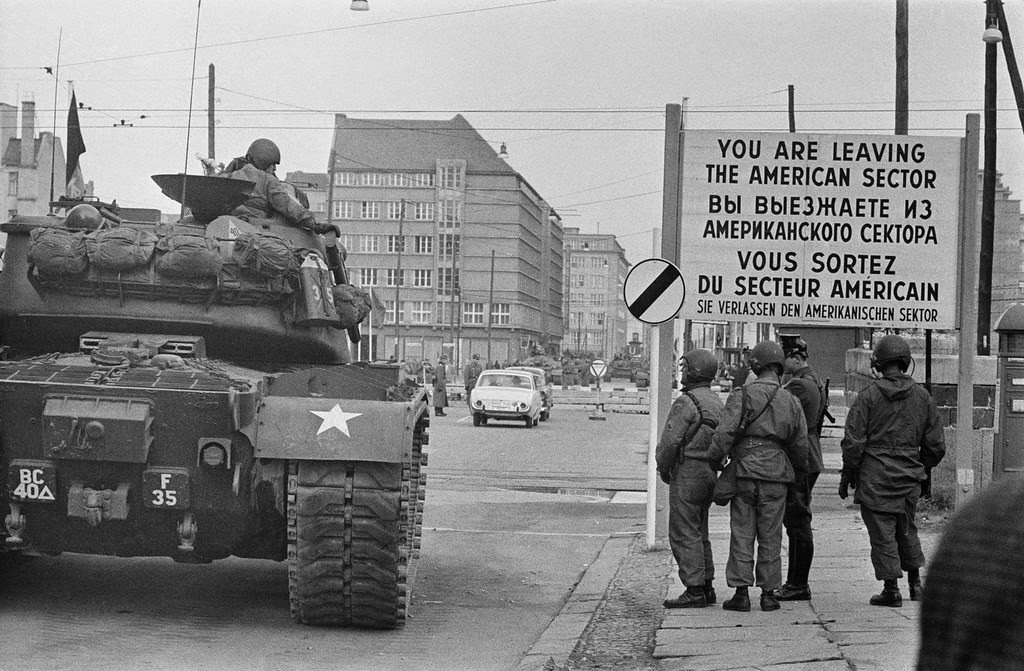
Armored steel dominates the street as an American tank idles near Checkpoint Charlie, its turret crowded with gear and its hull marked with a stark white star. A small group of U.S. troops stands to the right, watching the crossing with the tense stillness that defined Cold War Berlin. Behind them, ordinary city life lingers in the background—cars, tram wires, and tall apartment blocks—reminding us how a divided metropolis tried to function under extraordinary pressure.
Most telling is the large multilingual sign announcing, “YOU ARE LEAVING THE AMERICAN SECTOR,” a blunt statement rendered in several languages for travelers and residents alike. In February 1961, that message carried more weight than simple directions; it hinted at the hardening border and the politics that turned streets into front lines. The checkpoint’s barriers and narrow lanes frame a corridor of control, where movement was scrutinized and symbols mattered as much as weapons.
For readers searching the story of Checkpoint Charlie, the Berlin Wall era, and American military presence in West Berlin, this photo offers a vivid snapshot of the moment just before the city’s division became physically irreversible later that year. The soldiers’ posture and the tank’s imposing silhouette convey deterrence rather than motion, as if the real battle was over nerves and narratives. Seen today, the scene captures how the Cold War could feel both routine and perilous—an everyday street transformed into a landmark of global confrontation.