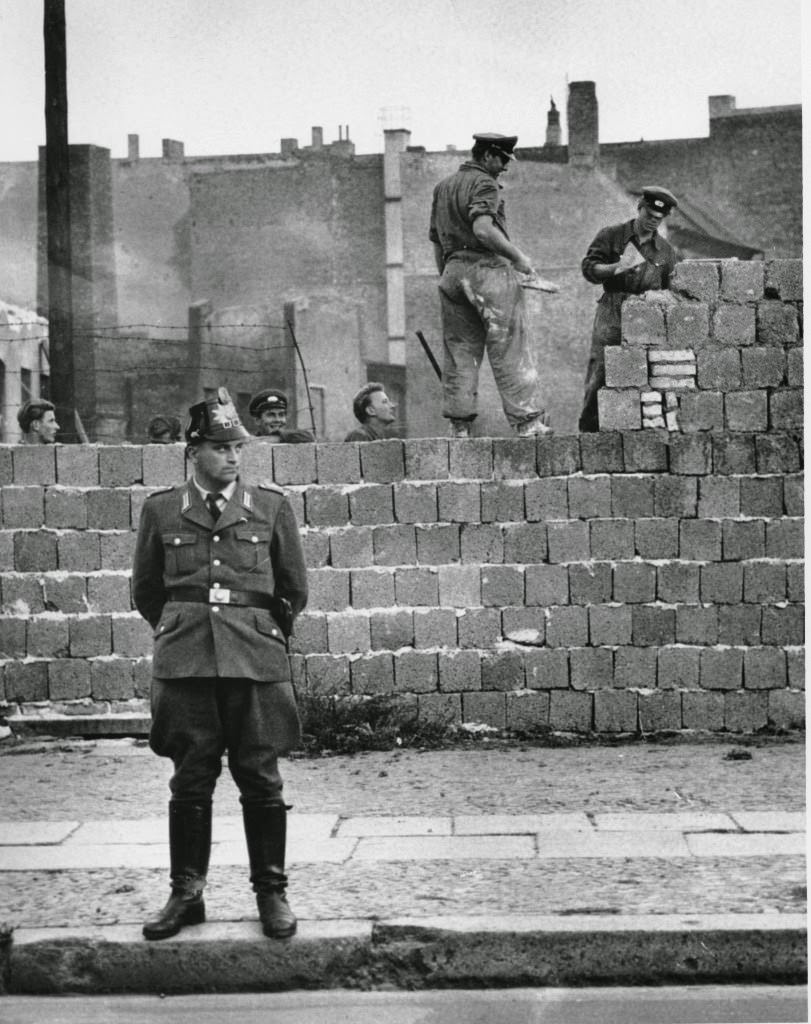
A lone West Berlin guard stands rigidly at street level, his posture calm but watchful, while behind him a rough wall of stacked concrete blocks rises like an unfinished sentence. The scene at Bernauer Strasse is all hard edges—uniform, masonry, barbed wire—set against a background of ordinary city rooftops that suddenly feel remote. Even without motion, the image carries the tension of a border being made permanent in real time.
On the other side, East Berlin workmen balance on the growing barrier, adding new blocks to increase its height, their tools and hands turning policy into architecture. The wall’s uneven courses and fresh mortar suggest improvisation, as if each layer is an answer to an urgent fear of escape and an equally urgent need to control movement. Faces appear in gaps and behind the wire, a reminder that this construction site is also a human crossroads where neighbors and families were forced into separate worlds.
Dated Oct. 7, 1961, the photograph captures an early phase of the Berlin Wall’s evolution—from barrier to fortified frontier—at one of its most symbolically charged stretches. For readers searching Cold War history, West Berlin, East Berlin, and the Berlin Wall at Bernauer Strasse, this moment distills the larger conflict into a single frame: authority standing guard, labor raising the divide, and a city’s daily life abruptly redefined by concrete. The result is a stark record of how quickly separation can be built, and how long its consequences can last.