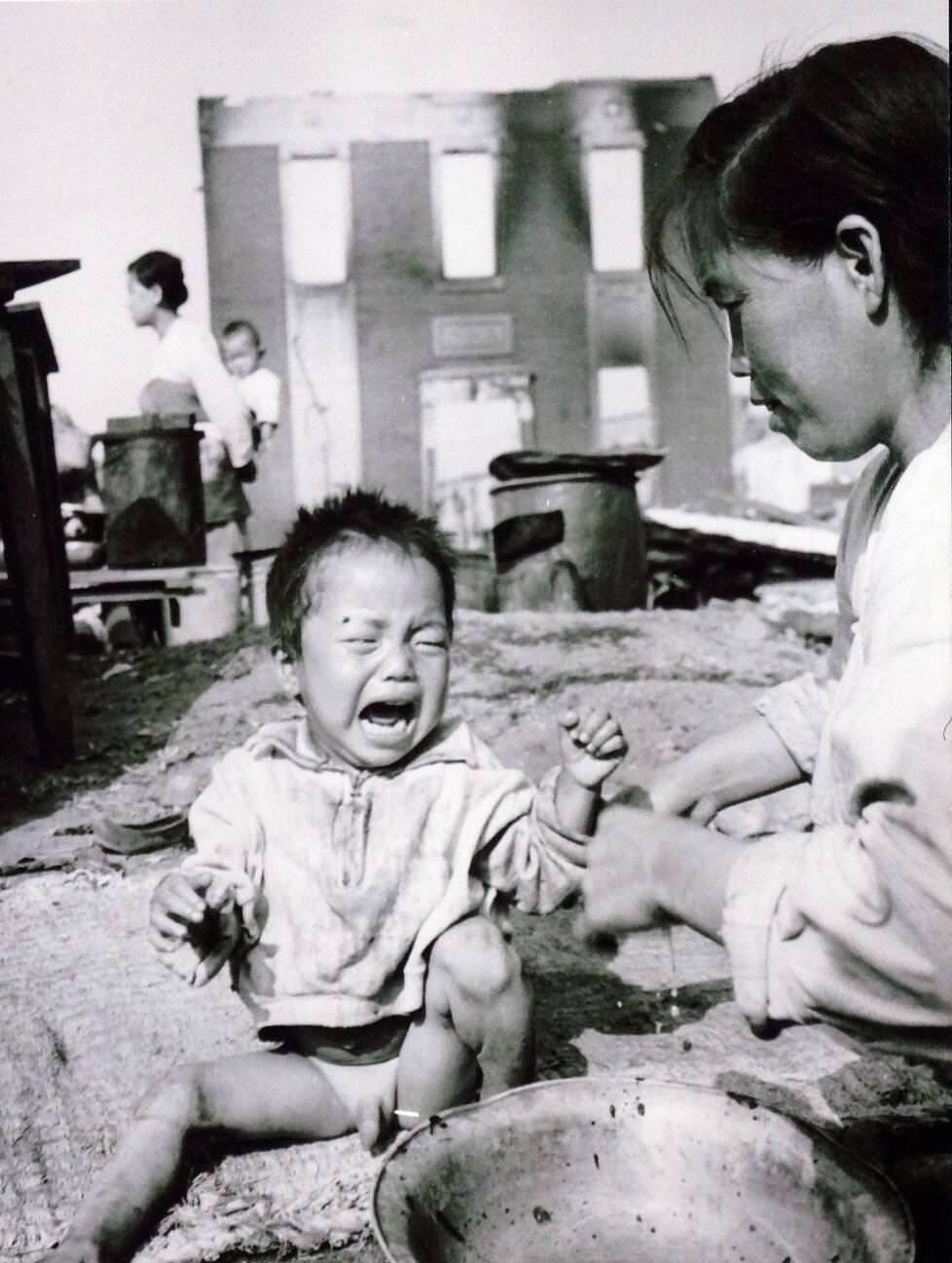
A small child sits on the bare ground, mouth open in a cry that feels louder than the frame itself, while an adult beside him turns in close with hands poised to soothe or tend to him. Behind them, the hard lines of damaged buildings and scattered household containers hint at a life interrupted, where ordinary routines—feeding, washing, finding shelter—have become fragile acts of survival. The scene is intimate and unposed, drawing the eye to the human cost of upheaval rather than to uniforms or battlefields.
The title’s reminder that the Korean War erupted only a few years after Korea’s independence from Japanese occupation adds a painful layer to what we see: a society barely emerging from one era of control and deprivation, then thrown into another cycle of violence and displacement. In this photograph, the war is measured in exhaustion and worry, in a caregiver’s focus and a child’s distress, and in the improvised setting that suggests temporary refuge. Such images help explain why the conflict is often remembered not only as a military confrontation, but also as a civil rupture that divided communities and families.
For readers searching the history of the Korean War in the 1950s, this photo offers a direct window into civilian experience—especially the vulnerability of children during wartime. The rough ground, the few belongings, and the strained expressions evoke the broader humanitarian crisis that accompanied the fighting: hunger, homelessness, and uncertainty about what would come next. Preserved and shared today, moments like this resist abstraction, anchoring big historical timelines in the quiet, relentless struggle to keep going.