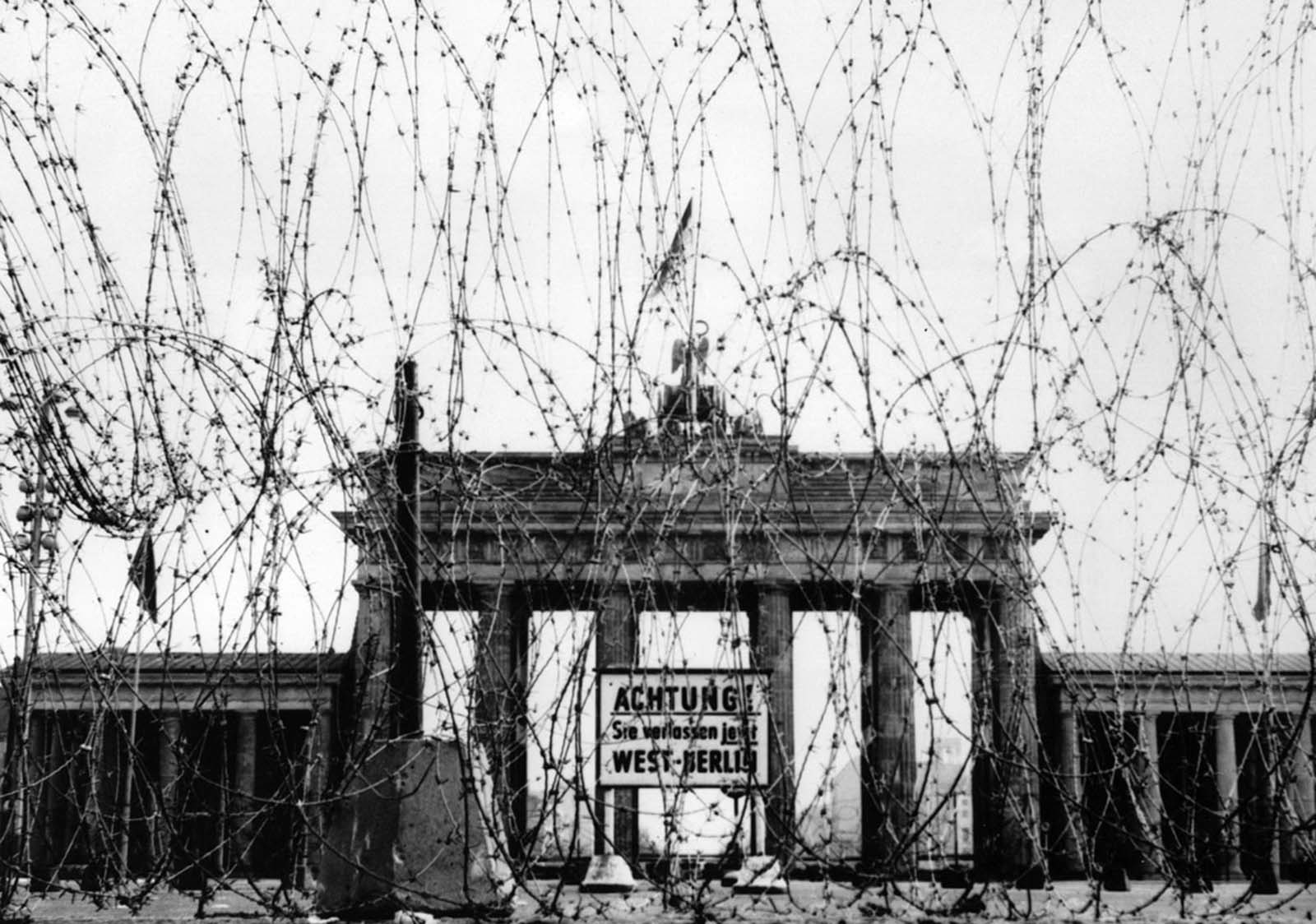
A tangled canopy of barbed wire dominates the foreground, turning the open sky into a web of sharp lines and throwing the Brandenburg Gate into uneasy relief behind it. Through the columns, a warning sign in German reads “ACHTUNG! Sie verlassen jetzt WEST-BERLIN,” a blunt notice that the famous monument had become a threshold rather than a promenade. Photographed in November 1961, the scene carries the immediacy of a city learning—day by day—what division would look like on the ground.
On the west side of the Brandenburg Gate, the barrier is described as a British “safety measure,” language that hints at the tense calculus of the early Berlin Wall period. The wire doesn’t merely block passage; it visually erases the ceremonial meaning of the gate, replacing civic grandeur with the logic of checkpoints and controlled movement. The emptiness of the space beneath the arch amplifies that transformation, as if public life has been pulled back from the border.
For readers searching Cold War history, Berlin Wall photographs, or the story of West Berlin in 1961, this image offers an unvarnished glimpse of how quickly symbols can be repurposed. It also complicates easy narratives by showing that security measures came from multiple sides, each framing its actions as protection while the city’s shared spaces narrowed. In a single frame, barbed wire, monumental architecture, and a stark warning sign combine to tell the larger story of a divided Berlin at one of its most defining crossroads.