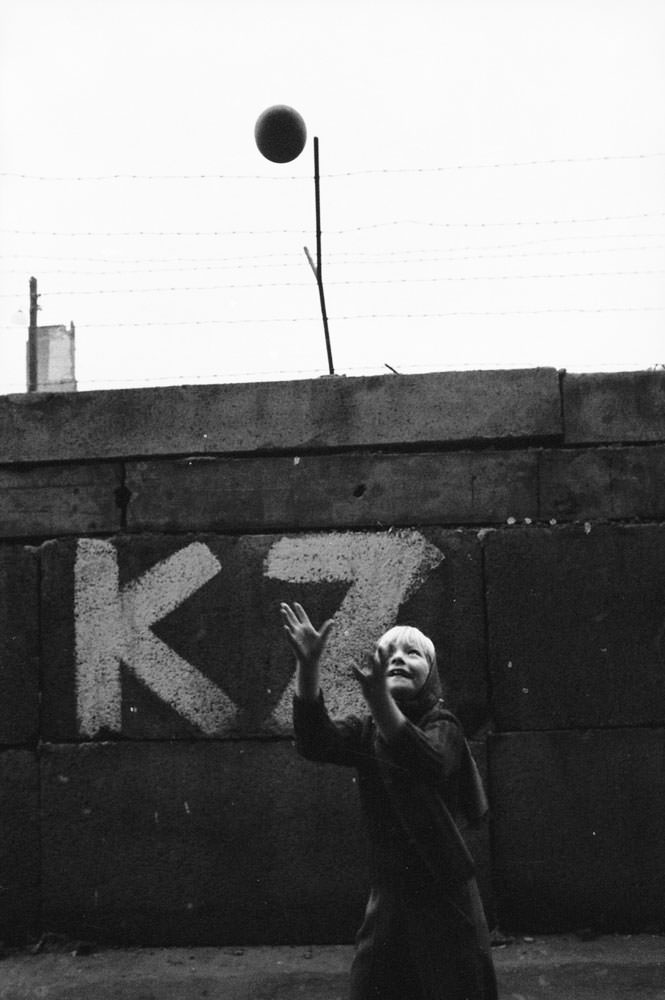
A ball hangs for a moment against a pale winter sky, suspended above concrete and barbed wire, while young Monika Heyne reaches up from the shadowed street below. The stark letters painted on the wall—part graffiti, part warning—turn a child’s game into a scene framed by authority and restriction. In January 1962, the Berlin Wall was still new enough to feel raw, its surfaces already bearing the marks of defiance, routine, and hurried adaptation.
Beyond the simple act of play, the photograph quietly stages the Cold War’s most intimate contradiction: ordinary life continuing in the immediate presence of a fortified border. The low angle emphasizes the barrier’s height and weight, and the thin line of wire above the concrete reads like a hard horizon cutting the city in two. Monika’s uplifted hands mirror the ball’s brief freedom, a fleeting arc that contrasts with the immovable architecture beneath it.
For readers searching Berlin Wall history, West Germany in 1962, or everyday life during German division, this image offers a powerful entry point without relying on spectacle. It reminds us that borders are experienced not only through speeches and checkpoints, but through sidewalks, games, and the small rituals of childhood. The tension is quiet yet unmistakable: a child’s laughter implied off-frame, and behind it the concrete certainty of a divided Berlin.