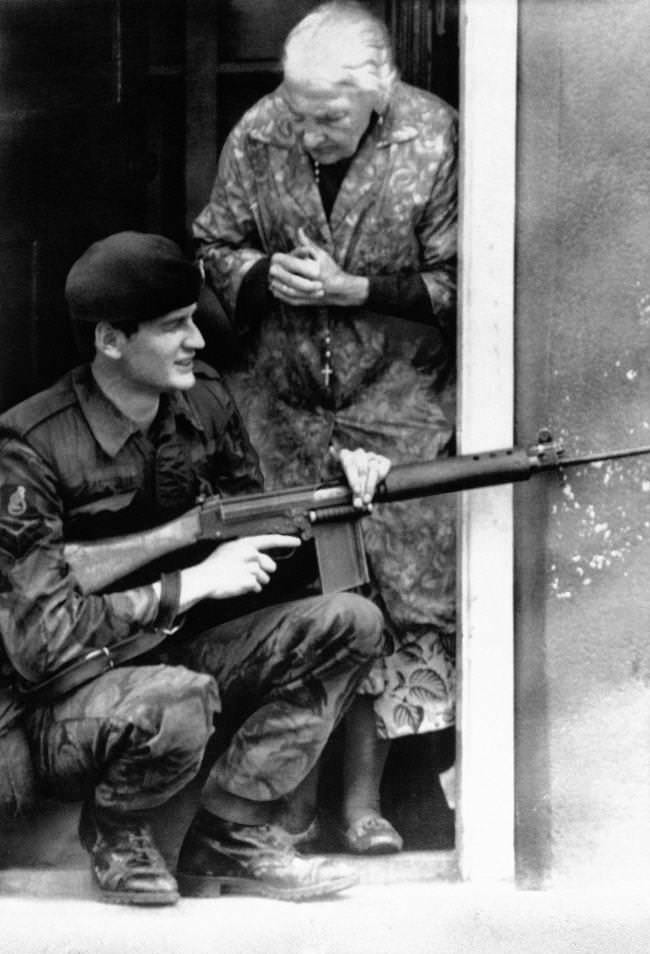
At a Belfast doorway in the market area, an elderly woman stands with her hands clasped, a rosary hanging against her coat like a quiet anchor in a moment of fear. Beside her, a British Army soldier crouches low, weapon ready, using the threshold as cover while he scans for danger beyond the frame. The tight space of the entryway turns a home into a frontline, capturing the uneasy collision between civilian life and armed patrols.
Dated August 11, 1971, the scene comes from a period when troops were moving through the Northern Ireland capital to flush out snipers reportedly barricaded in a bakery. The contrast is stark: devotion and vulnerability in the woman’s posture, discipline and alertness in the sharpshooter’s stance. Even without hearing the street outside, the photograph conveys the tension of sudden raids, contested neighborhoods, and the heavy presence of soldiers among ordinary residents.
For readers exploring civil wars and the Troubles in Northern Ireland, this historical photo offers more than a record of military action—it preserves the human cost carried by those caught at their own doors. The rosary, the clasped fingers, and the soldier’s careful crouch are details that ground the larger political conflict in a single lived instant. As a piece of Belfast history, it reminds us how quickly routine spaces can be reshaped by violence, security operations, and uncertainty.