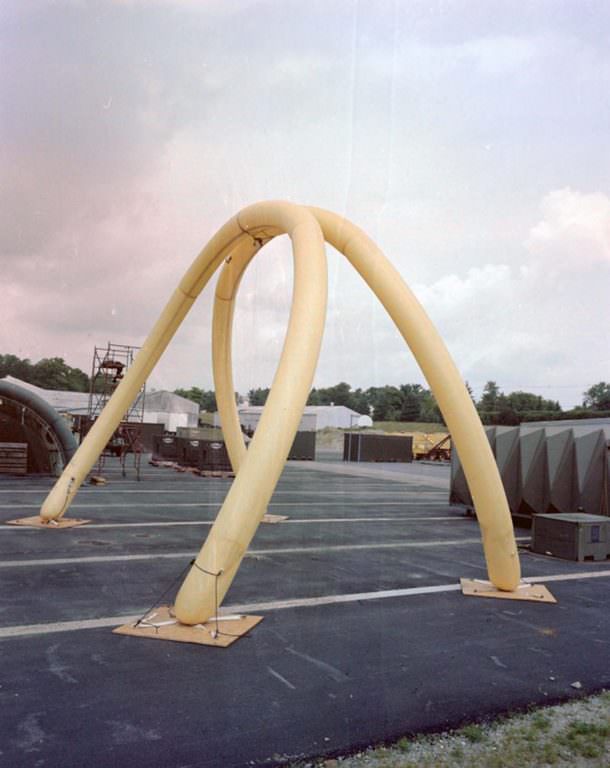
Two pale inflatable arches rise from a paved lot, their thick tubular bodies curving overhead like oversized ribs ready to support something larger. Anchored to square base plates, the air-filled structure hints at a shelter system designed to go up quickly with minimal hardware, a practical answer to the perennial problem of covering space without hauling heavy steel frames. In the background, scattered equipment and tent-like forms suggest a demonstration or test area where temporary buildings could be assembled, evaluated, and moved on short notice.
Seen through the lens of 1979 invention culture, this kind of inflatable architecture speaks to an era fascinated by portability, modular design, and rapid deployment. The arches are not simply novelty; they represent a structural idea—using air pressure to create strength—scaled for real-world use in field operations, emergency response, or short-term work sites. The open span between the legs implies a shelter could be stretched or clipped across multiple arches, creating an enclosed bay that’s lighter than conventional framed buildings.
For readers interested in historical technology and disaster-ready design, “Inflatable arches for temporary shelter, 1979” is a small snapshot of big ambitions: quicker setup, flexible footprint, and infrastructure that could travel. The simplicity of the curved tubes contrasts with the complex logistics they aim to solve, from weather protection to on-site storage and workspace needs. As a piece of invention history, the photo invites a closer look at how experimental engineering tried to make shelter as mobile as the people and missions that required it.