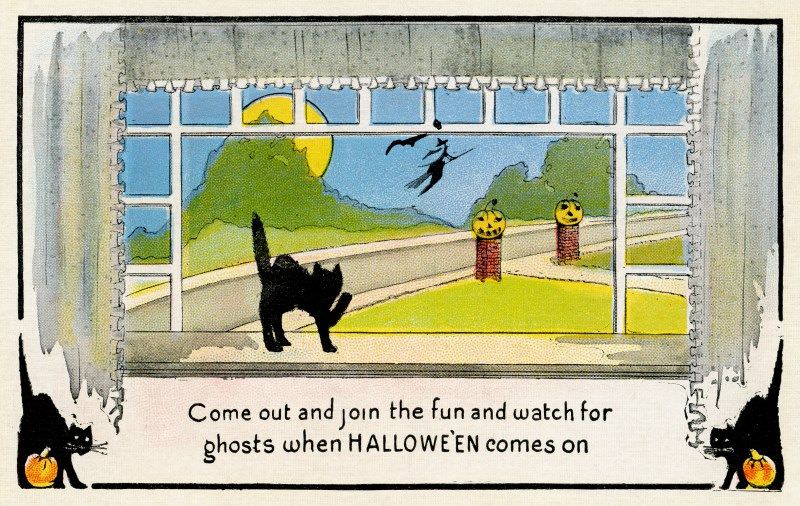
A playful Halloween greeting unfolds like a scene glimpsed through a window, complete with a bold black cat poised on the sill and a pale moon rising behind rounded green hills. Beyond the frame, a tiny witch silhouette sweeps across a bright sky, while jack-o’-lantern faces perch atop fence posts, turning an ordinary path into a festive haunt. The hand-colored look and simple, confident lines give the artwork the charm of early holiday ephemera—part invitation, part gentle shiver.
The caption, “Come out and join the fun and watch for ghosts when HALLOWE’EN comes on,” captures an older spelling and a community-minded spirit that feels closer to a neighborhood party than a modern horror marathon. Rather than leaning into gore, the design trades on familiar symbols—cat, moon, witch, pumpkins—to signal mischief and make-believe. Even the icy, dripping border effect around the window suggests autumn chill and candlelit stories told for thrills that stay comfortably safe.
For collectors and Halloween historians, images like this offer a snapshot of how seasonal traditions were marketed and shared through printed artworks and cards. The composition balances whimsy with just enough eeriness to suit the title, “Watch for Ghosts When Halloween Comes,” making it ideal for a WordPress post about vintage Halloween art, classic holiday illustration, or the evolution of trick-or-treat aesthetics. As a piece of nostalgic visual culture, it reminds us that Halloween’s enduring power often lies in suggestion—one shadow, one grin, and an invitation to step outside after dark.