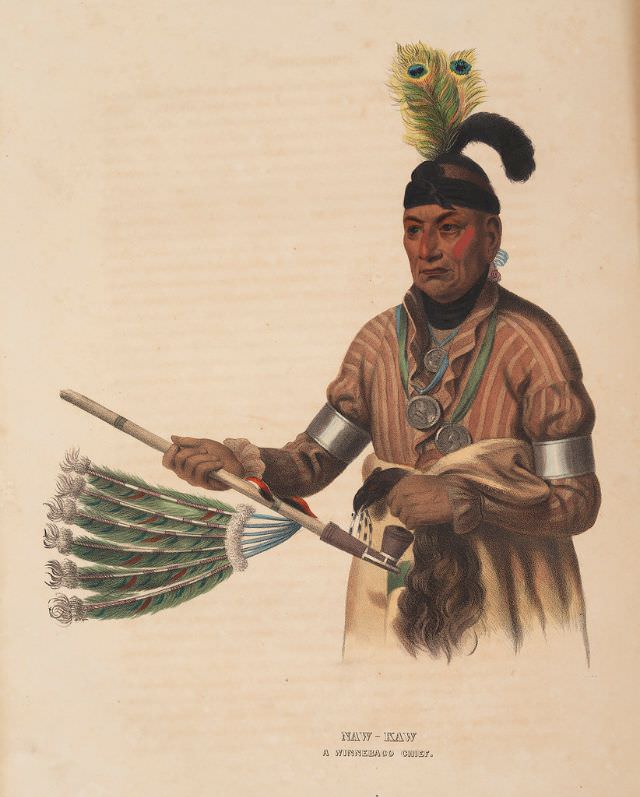
Rendered as a finely detailed portrait, “Naw-Kaw, A Winnebago Chief” presents a dignified figure posed in three-quarter view against an uncluttered background that draws the eye to clothing, ornament, and expression. The artist’s careful modeling of the face and hands creates a sense of presence, while the soft, restrained palette keeps the emphasis on cultural details rather than scenery. Below the figure, the printed caption anchors the work as a named depiction, suggesting it was meant to be read as both art and record.
Attention settles on the regalia: a headpiece topped with upright feathers, layered necklaces with prominent medallions, and wide metal armbands that catch the light. In one hand he holds a long staff or lance, decorated near the end with a fan-like spray of feathers arranged in green and white, each tip marked with a small circular motif. A fur pelt draped over the opposite arm adds texture and weight, reinforcing the portrait’s ceremonial tone and the sitter’s status.
As historical artwork, this image invites readers to consider how Indigenous leaders were represented in printed portraits meant for distant audiences. The clean composition and descriptive costume elements make it a strong choice for anyone researching Winnebago history, Native American portraiture, and early ethnographic illustration in North America. For collectors and historians alike, it stands as a vivid reminder that portraits like this shaped public perception—preserving visual details while also reflecting the artistic conventions and viewpoints of their era.