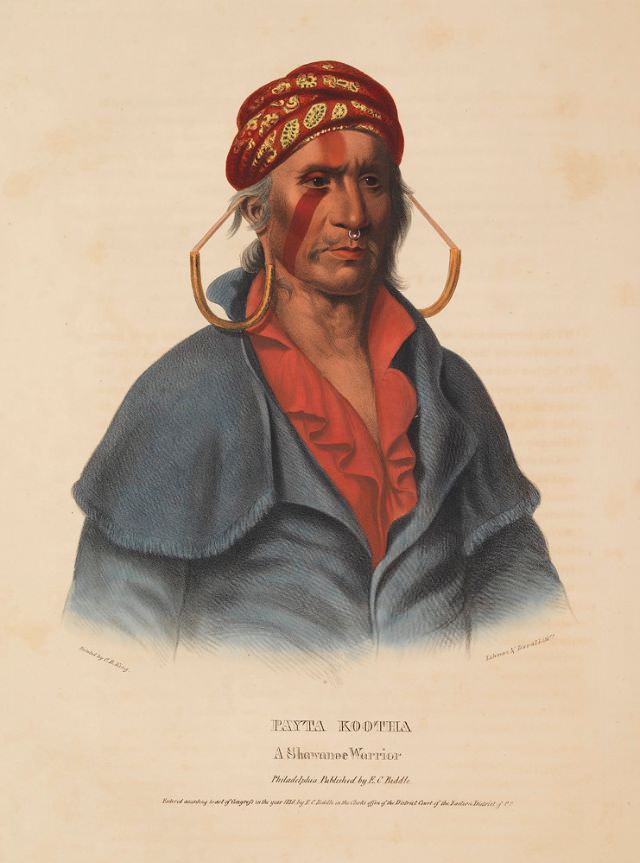
Rendered with the careful clarity of a formal portrait, “Payta Kootha, A Shawanee Warrior” centers on a dignified figure whose steady gaze meets the viewer without sentimentality. A patterned headwrap in warm reds and golds crowns the composition, while bold red face paint, a nose ring, and prominent hoop earrings draw the eye to the sitter’s features. The clothing—layered, heavy, and textured—contrasts with a vivid red garment beneath, giving the artwork both visual depth and a sense of presence against the plain background.
Details like these matter because they reveal how Native identity was translated into print culture through costume, adornment, and posture. The artist’s approach feels both observational and staged: the individualized facial lines suggest lived experience, yet the clean backdrop and centered framing echo the conventions of studio portraiture. For readers interested in Shawnee history and Indigenous representation, the image becomes a study in how warriors were depicted for audiences who often encountered Native people through illustrations rather than direct community voices.
The caption beneath the portrait—naming Payta Kootha and identifying him as a Shawanee warrior—anchors the work as a titled historical artifact as much as a piece of art. As a WordPress feature, this post is an invitation to look closely at the visual language of the era: what is emphasized, what is simplified, and what survives in the record through prints like this one. It’s an evocative addition for anyone searching for historical Native American portraits, Shawnee artworks, or early printed illustrations that shaped public memory.