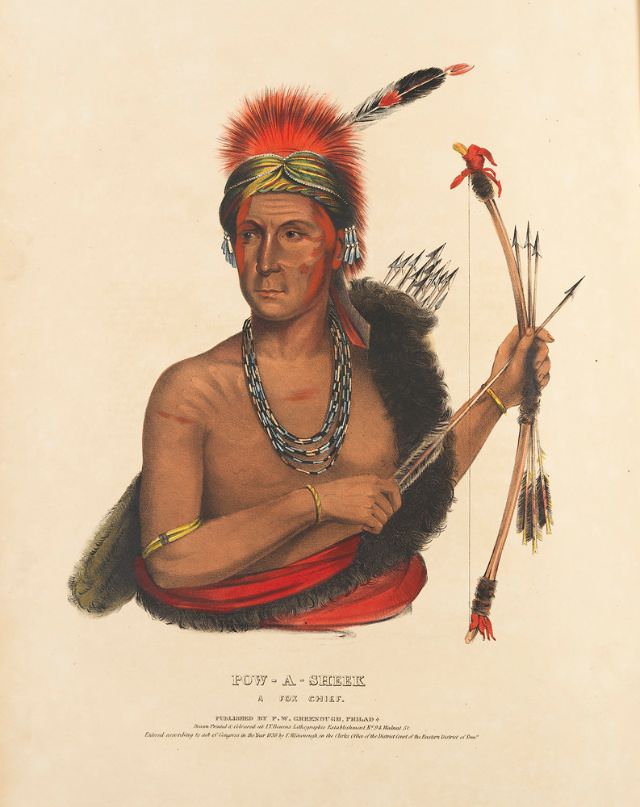
Rendered with the poise of a formal portrait, “Pow-A-Sheek, A Fox Chief” presents a Native leader in three-quarter view, his gaze turned slightly aside as if listening beyond the frame. A vivid headdress with upright feathers crowns the figure, while painted markings and layered beadwork draw the eye across the face and chest. The careful coloring and clean background give the scene a gallery-like clarity, making it as much an artwork as it is a historical record.
Details of material culture anchor the composition: a fur or hide wrap draped over the shoulder, a red cloth at the waist, and a bundle of arrows rising behind the arm. In one hand he holds a bow, its line and ornaments rendered with precision, and the combination of weapons and regalia suggests both authority and responsibility. The title’s reference to a Fox chief points readers toward the wider story of the Fox (Meskwaki) people and how Indigenous leadership was portrayed for non-Native audiences.
As a WordPress feature, this historical illustration invites a closer look at the visual language of the period—how artists used posture, costume, and symbolic objects to communicate identity and status. The inscription beneath the figure reinforces that this was intended for circulation, not private viewing, placing it within a broader tradition of printed portraits of Native American leaders. Readers searching for “Pow-A-Sheek,” “Fox Chief,” “Meskwaki history,” or “Native American portrait art” will find in this post an accessible entry point into the era’s aesthetics, documentation, and bias.