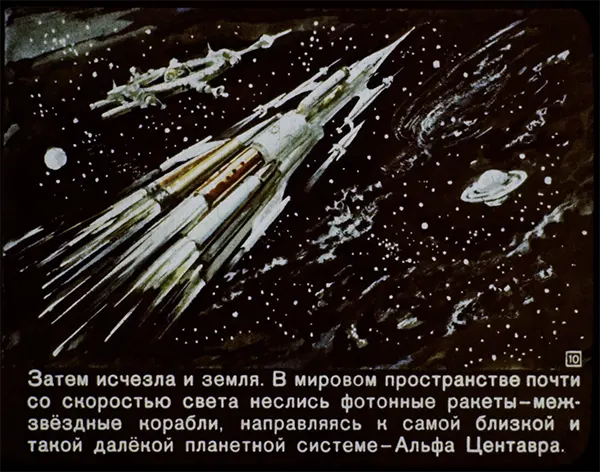
Across a star-studded void, sleek rocketships surge forward in bright, tapered streaks, their hulls rendered with the sharp, confident lines of classic space illustration. Smaller craft ride in formation behind the lead vessel, while distant planets and swirling nebula-like textures give the scene a sense of depth and scale. The composition leans into speed—everything seems pulled into motion, as if the viewer is watching a cinematic cut from familiar skies into the open ocean of interstellar space.
Russian text along the bottom anchors the artwork to a filmic narrative: the Earth vanishes from view, and photon-powered interstellar rockets race outward, nearly at the speed of light. That idea—light itself as propulsion—sits at the crossroads of science communication and imaginative futurism, the kind of bold promise that fueled public fascination with cosmic travel. Alpha Centauri appears as the destination in the caption, a nearby star system turned into a symbol of both “nearest” and “faraway,” capturing how space can feel simultaneously close in theory and impossibly distant in practice.
For readers interested in retro science fiction art, spaceflight history, and the visual language of the Space Age, this piece offers a vivid snapshot of how the future was once pictured. The dramatic perspective, the dense field of stars, and the purposeful fleet all contribute to a story of departure—leaving Earth behind and betting everything on speed, light, and engineering. As a WordPress feature image, it pairs well with discussions of interstellar travel concepts, Soviet-era sci‑fi aesthetics, and the enduring allure of Alpha Centauri as a target for humanity’s next great voyage.