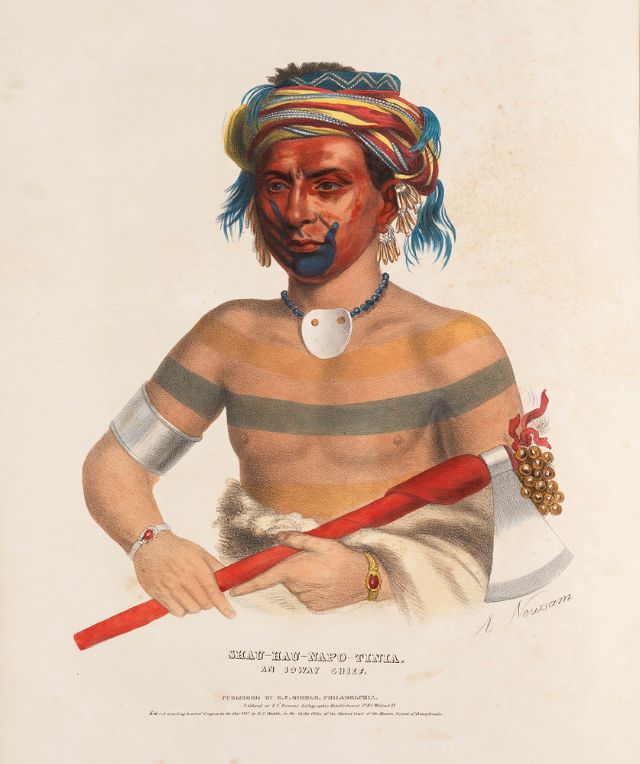
Seen in three-quarter view, Shau-Hau-Napo-Tinia is rendered with a calm, steady presence that draws the eye first to his face paint and then outward to the carefully arranged regalia. A richly patterned turban-like headwrap crowns the portrait, accented with tufts and feathers, while long earrings frame his features. Across his bare chest run broad painted bands, and a shell-like pendant hangs at the center, suggesting the sitter’s status and the artist’s intent to record distinctive cultural markers.
Color and texture do much of the storytelling here: the warm skin tones contrast with the bold blue pigment on the cheek and jaw, and the soft fur wrap at the waist offsets the gleam of metal armbands and bracelets. He holds a red staff or baton horizontally, a compositional anchor that emphasizes authority and ceremony. The overall effect is both intimate and formal, the kind of nineteenth-century Native American portraiture that aimed to present leaders as recognizable individuals rather than anonymous types.
For readers searching for “Ioway chief” imagery or historical Indigenous portraits, this artwork offers a striking example of how printed art shaped public understanding of Native leaders. At the same time, it invites a slower look—at adornment, posture, and the choices made in translating a living person into a collectible image. As a WordPress feature, it pairs well with discussion of Ioway history, early American art and illustration, and the ways museum and archive images still influence how we picture the past.