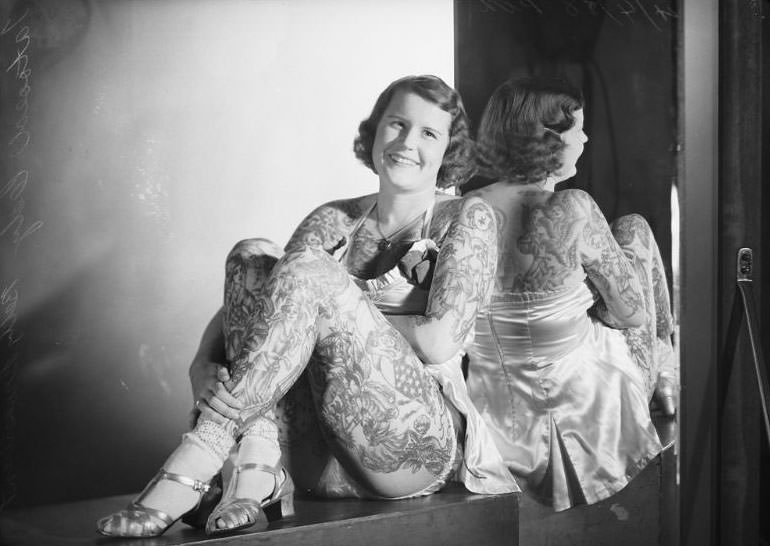
Betty Broadbent, billed as the “Tattooed Venus,” appears in Sydney on 4 April 1938 in a poised studio-style portrait that balances glamour with spectacle. Seated with a relaxed, confident smile, she turns her body so the camera can read the dense tapestry of ink across her arms and legs, while a mirror behind her offers a second view and doubles the impact. The satin-like dress, heeled sandals, and carefully set hair place the scene firmly in the late interwar era, when publicity photography helped performers travel their fame far beyond the stage.
Across the image, tattoos become both costume and biography, arranged like an illustrated wardrobe that never comes off. Broadbent’s pose is inviting rather than confrontational, suggesting a performer practiced in controlling how audiences look—an important detail for a woman whose body was central to her act. The mirrored composition serves as a clever visual strategy: one glance delivers front and back, turning a personal canvas into a curated display for newspapers, posters, and promotional use.
In the wider history of tattoo culture, portraits like this document the moment when tattooed women occupied a complicated space between empowerment and commodification. The title’s specificity—Sydney and the exact day—anchors the photograph in a real stop on an international circuit, linking Australian entertainment history with the global sideshow world. For readers searching “Betty Broadbent Tattooed Venus Sydney 1938,” this post offers a vivid encounter with a performer who helped shape modern fascination with tattoo art, celebrity image-making, and the boundary between fine art and popular spectacle.