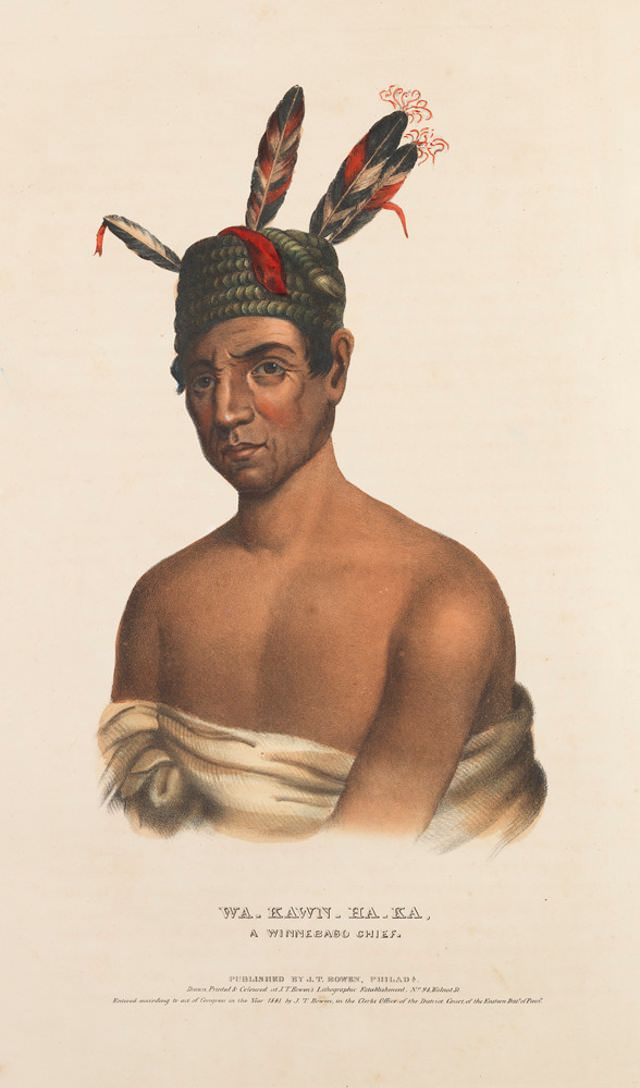
Wa-Kawn-Ha-Ka is presented in a carefully colored portrait that emphasizes both dignity and individuality, with the sitter turned slightly to the side and meeting the viewer’s gaze. A woven cap sits close to the head, rising into tall feathers accented with red, while a light wrap drapes across the shoulders and chest. The clean, pale background keeps attention on expression and regalia, letting subtle shading and warm tones define the face and form.
Below the figure, the printed caption identifies him as “A Winnebago Chief,” making the artwork part of a broader tradition of nineteenth-century portrait prints that circulated Indigenous leaders to distant audiences. The hand-finished look—crisp outlines softened by watercolor-like hues—signals an intent to balance documentary detail with an idealized, formal presentation. In the absence of a setting or surrounding narrative, the portrait relies on clothing, posture, and directness to convey authority.
For readers searching for historic Native American art, Winnebago (Ho-Chunk) history, or early American portraiture, this image offers a striking example of how identity was recorded and reproduced in print culture. At the same time, it invites a slower viewing: the careful arrangement of feathers, the textured headwear, and the quiet intensity of the eyes suggest a person rendered as more than a type. Consider it an artifact of representation—beautiful, influential, and worth approaching with curiosity about both the subject and the world that framed him.