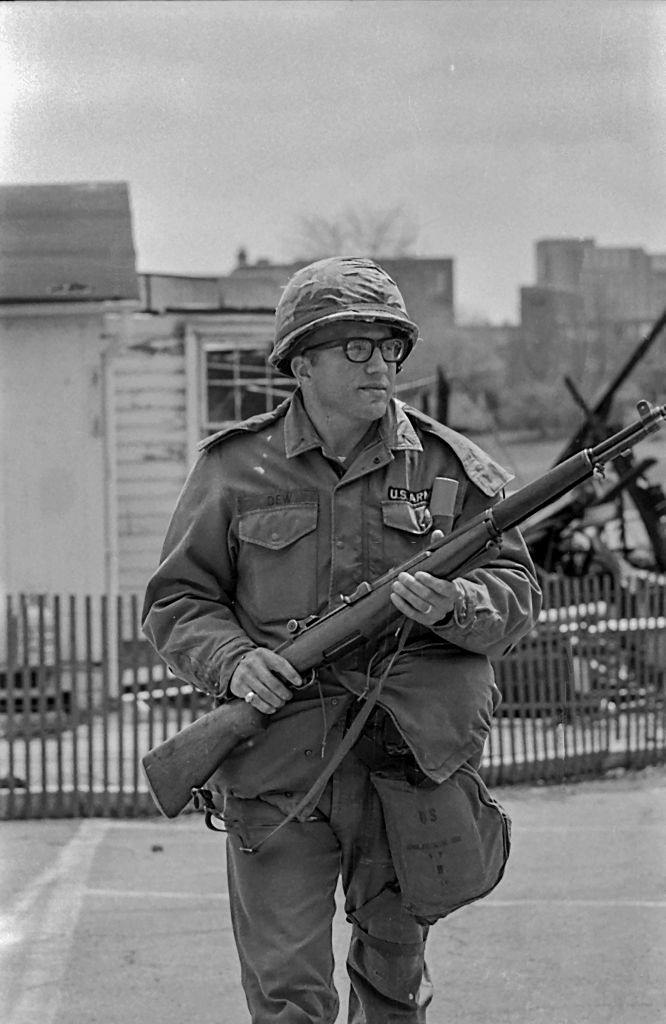
A young National Guardsman moves through the scene with a rifle held across his chest, helmet strapped on and glasses catching the light. His field jacket bears a “U.S. ARMY” tape, and the set of his shoulders suggests alertness rather than ease. Behind him, a campus-like backdrop of modest buildings, fencing, and bare trees places the viewer in the tense atmosphere remembered from Kent State in 1970.
The photograph’s power lies in its quiet details: the firm grip on the weapon, the gear slung at his side, and the sideways glance that implies unseen activity just out of frame. It reads as a snapshot of domestic deployment, when military presence became part of everyday American streets and sidewalks. In the broader shadow of the Vietnam War era, such images show how protest, authority, and uncertainty collided close to home.
Kent State remains a defining reference point in U.S. history and in the visual record of campus unrest, and this image contributes to that ongoing memory. For readers searching for National Guard at Kent State, 1970, or Vietnam War protest history, the photo offers a stark, human-scale view of the moment. It invites reflection on how quickly ordinary spaces can become contested ground—and how a single figure can symbolize an entire national crisis.