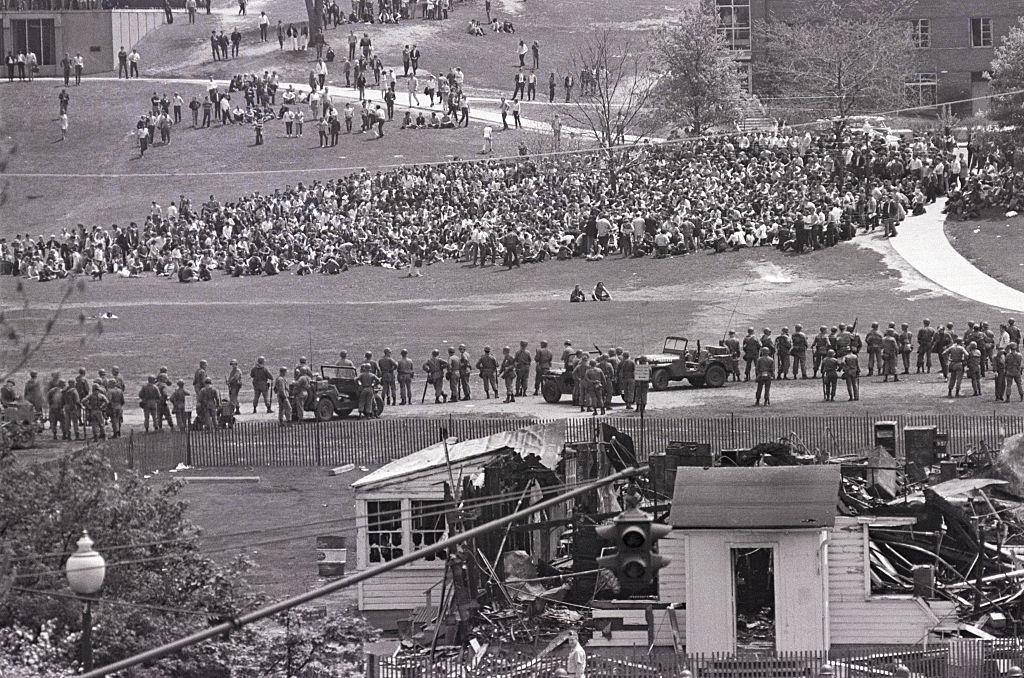
Across a broad hillside at Kent State University, a dense crowd of students gathers while a long line of National Guardsmen stretches across the foreground, forming a hard boundary between civilians and armed authority. Military vehicles sit behind the troops, and the campus landscape—sloping lawn, walkways, and buildings—turns into a stark stage for confrontation. The sheer scale of the assembly is striking, suggesting a protest that had swelled beyond a small demonstration into a moment the whole campus could feel.
May 4, 1970, sits at the center of America’s Vietnam War era, when student protest and official response increasingly collided in public view. The title’s reference to tear gas underscores how quickly a political argument could become a physical crisis, with crowd control tactics applied to young people on their own grounds. From this elevated vantage, the scene reads like a tense standoff: students clustered in mass, guards spaced with practiced rigidity, and the air between them charged with uncertainty.
For readers searching Kent State May 4, 1970, Vietnam War protests, or National Guard tear gas on campus, this photograph offers an immediate, unsettling geography of the event—who stood where, and how power was arranged in space. It also hints at the broader story of the early 1970s: the widening generational divide, the urgency of antiwar activism, and the consequences when dissent met militarized policing. Even without hearing a single shout, the image conveys a turning point in how Americans understood protest, authority, and the cost of political conflict.