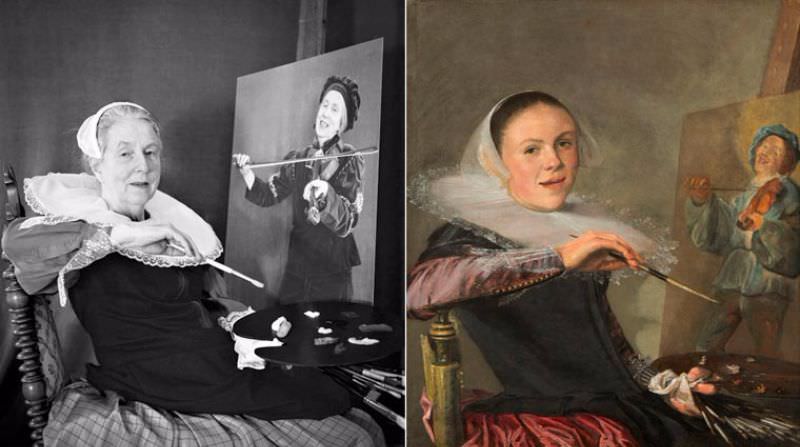
Judith Leyster’s “Self Portrait” greets the viewer with a confident, almost conversational glance, as if the painter has just turned from her work to acknowledge our presence. Dressed in fine clothing with a crisp white collar and a light head covering, she sits at ease with palette and brushes in hand, presenting herself not as a passive sitter but as a working artist. The composition invites close looking: the soft modeling of her face, the sheen of fabric, and the gentle warmth of the background all reinforce a sense of lively immediacy.
Behind her, an easel holds a partially finished scene featuring a musician, a clever in-painting that quietly advertises her skill at genre subjects. That secondary figure adds motion and humor, while the angled brush and poised hand suggest the precise moment of making—an artist caught mid-stroke. The visual dialogue between painter and painted turns the self-portrait into a statement about authorship, craft, and the pleasure of creating images that feel animated and present.
For readers exploring Dutch Golden Age art and women artists in early modern Europe, this artwork serves as both personal declaration and professional calling card. Leyster’s self-representation balances refinement with labor, positioning her studio practice as something worthy of public attention. As a WordPress feature image or gallery entry, “Self Portrait – Judith Leyster” offers rich SEO-friendly themes—self portraiture, Baroque painting techniques, studio life, and the history of female painters—while rewarding viewers with its wit, elegance, and unmistakable self-assurance.