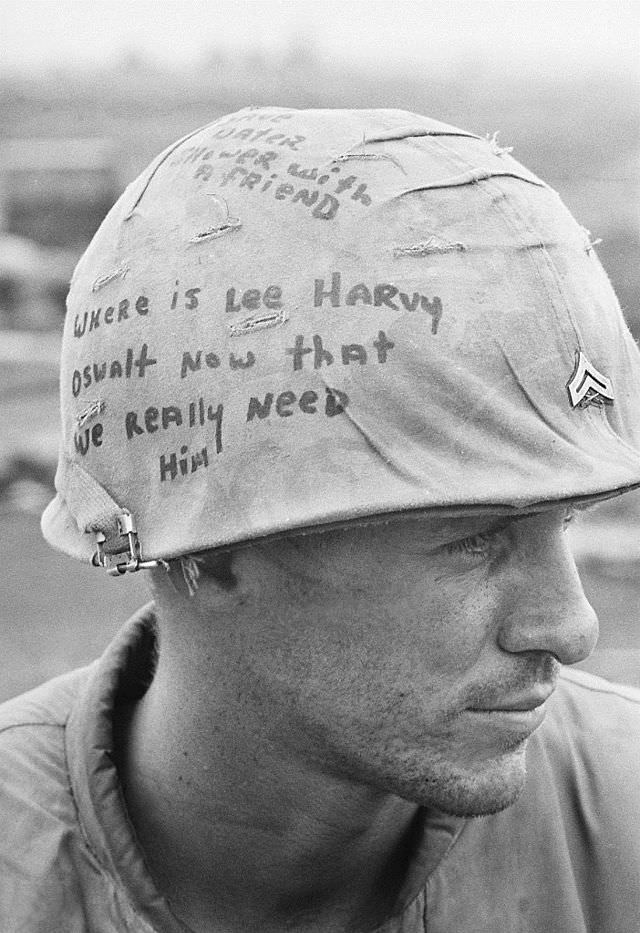
Scrawled across a battered combat helmet, the line “Where is Lee Harvy Oswald now that we really need him” lands with the dark, biting humor that often surfaced among troops during the Vietnam War. The misspelling and uneven lettering feel immediate and personal, as if the message was written quickly between movements, using whatever marker or paint was at hand. In a single close-up, the helmet becomes both protective gear and a portable bulletin board for frustration, sarcasm, and surviving the day.
The reference to Oswald—forever tied to American political trauma—turns the inscription into a blunt piece of soldier slang, hinting at anger toward leadership and the wider machinery of war without spelling it out. A visible sergeant chevron on the side adds another layer, suggesting this wasn’t the private gripe of a new recruit alone, but part of a broader culture where rank did not erase doubt. The soldier’s downcast gaze and stubbled face deepen the mood, contrasting the joke’s sharpness with an exhausted, inward-looking calm.
For readers searching Vietnam War photographs, wartime graffiti, or the lived texture of military history, this image offers an unforgettable entry point. It reminds us that history isn’t only recorded in speeches and headlines; it’s also written in cramped handwriting on steel, carried through heat and uncertainty. The title’s question lingers not as a literal plea, but as a snapshot of how people cope when national narratives collide with personal risk.