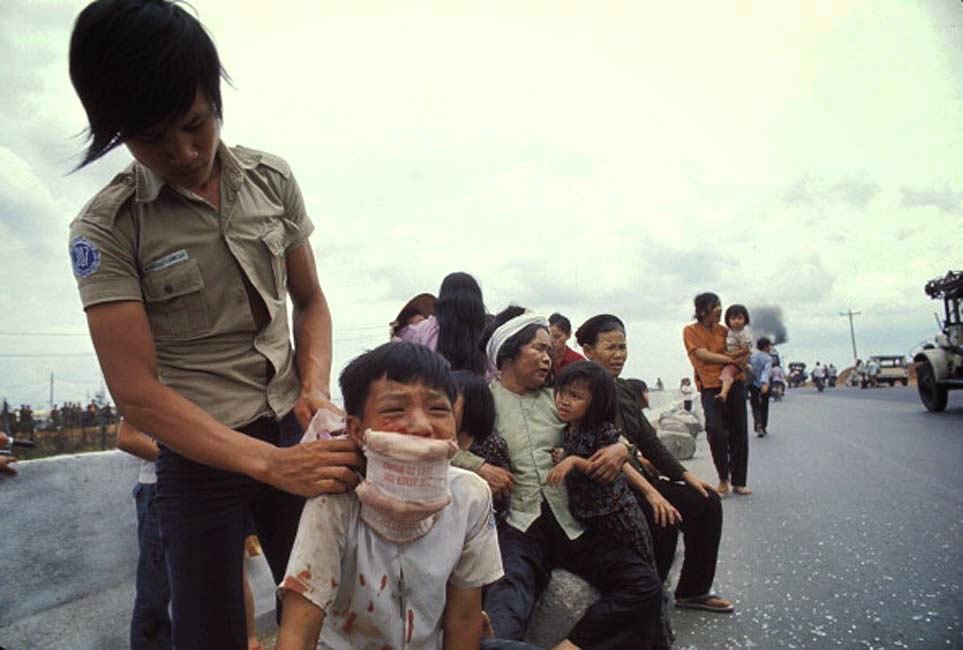
Tension hangs over this roadside scene from the final days of the Vietnam War, as exhausted civilians cluster on the edge of a broad highway with vehicles streaming past. In the foreground, a uniformed aid worker leans close to a distressed boy, adjusting a cloth around his face while the child’s shirt shows fresh stains from the chaos of flight. Behind them, families sit or crouch in tight groups, clutching children and small bundles, their faces turned toward the road as if waiting for a break in the uncertainty.
Along the route, the details tell a larger story of the Fall of Saigon in April 1975: sudden displacement, improvised medical care, and the fragile order that appears when ordinary people are forced into motion. The crowd’s posture—half-resting, half-ready to move again—suggests how quickly safety could vanish, and how little time there was to plan. Even the open sky and distant haze add to the sense of vulnerability, with the road itself becoming both escape corridor and bottleneck.
For readers searching Vietnam War history, this photo offers a sobering glimpse into the human cost behind headlines about military collapse and political transition. It centers not on armies or leaders, but on civilians navigating fear, injury, and responsibility for loved ones while trying to keep moving. As a historical image of the Fall of Saigon and the refugee exodus, it preserves a moment when survival depended on strangers’ help and a family’s determination to endure.