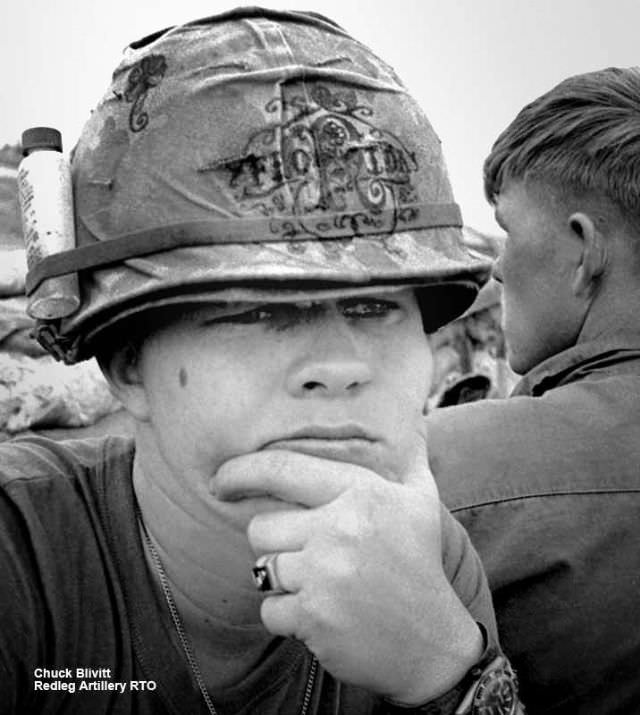
A young U.S. soldier stares past the camera with his chin resting on his hand, the pose somewhere between bored, thoughtful, and worn down. His helmet cover is marked with a decorative, hand-drawn slogan—an improvised bit of satire that turns standard-issue gear into a personal billboard. Even in a tight close-up like this, you can feel how quickly individuality had to be asserted in a world of uniforms and routines.
Helmet graffiti became a small language during the Vietnam War, carrying jokes, complaints, bravado, and dark humor across firebases and patrols. The lettering here, framed by curling flourishes, hints at the care some troops took in crafting a message that could be read in passing, photographed, and remembered. It’s a reminder that soldiers didn’t just carry rifles and rucks—they carried opinions, moods, and the need to be seen as more than a serial number.
Seen today, the satirical slogans scrawled on Vietnam War helmets offer historians a grassroots archive of morale and identity. They show how humor and irony could function as coping mechanisms, a way to push back against fear, monotony, or the distance from home. For readers searching Vietnam War photos, this close portrait underscores the human impulse to leave a mark—even on the most regulated pieces of military life.