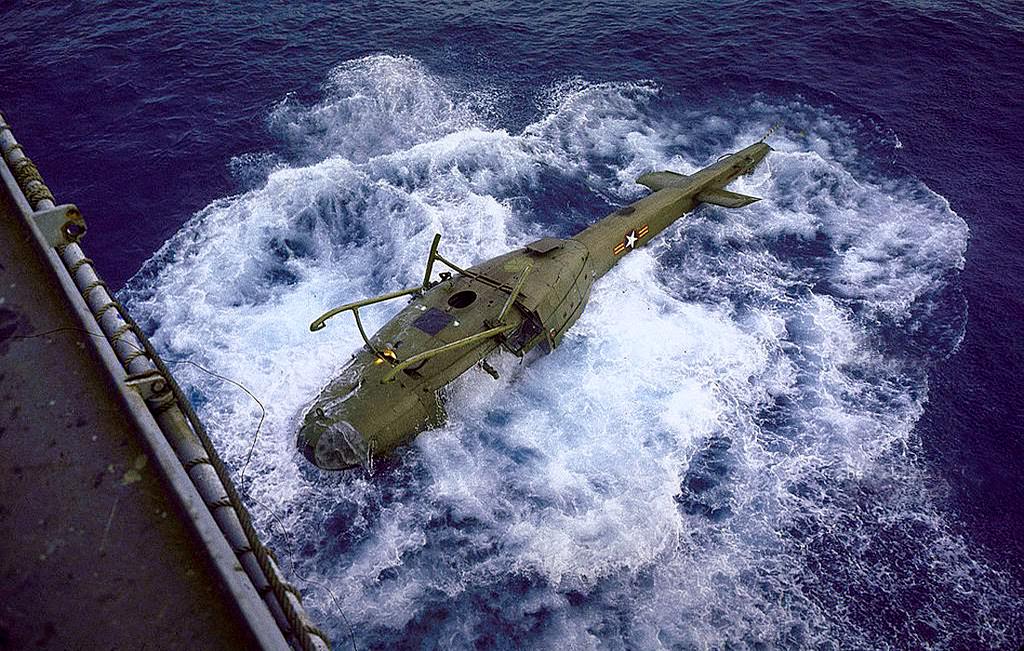
A lone helicopter churns the dark sea into a ring of white foam as it begins to sink beside the hull of an aircraft carrier, its rotor and tail still visible for a brief, haunting moment. The painted insignia on the fuselage hints at its Vietnamese origin, while the angle of the shot—taken from the ship’s edge—puts the viewer uncomfortably close to the decision unfolding in real time. Salt water climbs higher over the aircraft’s body, turning a machine built for rescue and flight into sudden wreckage.
In the frantic final days of the Vietnam War and the fall of Saigon, carrier decks became lifelines crowded with incoming aircraft and evacuees. Space was finite, and every landing demanded room that simply didn’t exist, forcing crews to make brutal calculations under pressure. Pushing helicopters overboard was not spectacle but triage—an emergency measure to keep the evacuation moving and to make space for American personnel and others desperate to get out.
For anyone searching Vietnam War history, Operation Frequent Wind imagery, or the fall of Saigon evacuation, this photograph crystallizes the cost of logistics in a collapsing moment. It also speaks to the strange contradictions of the era: technology at its peak, humanity at its limit, and the ocean swallowing the hardware of a conflict that was ending but far from resolved. The sinking helicopter lingers as a powerful symbol of departure—abrupt, irreversible, and witnessed from just a few feet away.