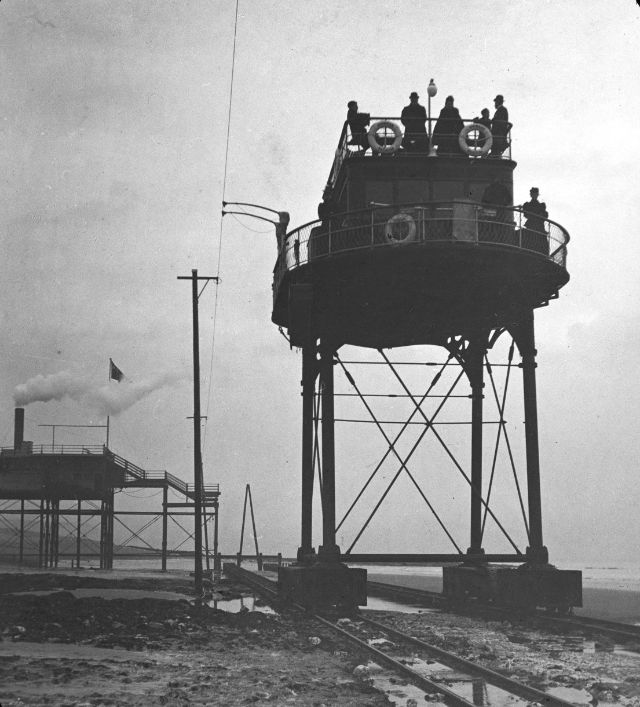
Silhouetted against a pale seaside sky, the Daddy Long-Legs Railway’s odd little carriage stands high on spindly legs, like a pier ride that decided to become a train. Passengers cluster on the upper deck behind railings, lifebuoys hung nearby, while the sea air and open horizon make the whole contraption feel part ship, part tram. Below, the narrow track runs along the beach, hinting at the bold idea behind this Brighton experiment: an electric railway that could skim the shoreline rather than fight it.
What makes the scene so compelling is the mix of elegance and improvisation—metal latticework supports, a boxy cabin, and a utilitarian power line stretching alongside the route. In the distance, another elevated structure and a plume of smoke suggest the busy, engineered coastline that grew with late-19th-century leisure culture. Even without close-up detail, the composition communicates motion and novelty: a seaside crowd trying out a machine that looks almost too strange to be real.
For anyone interested in Victorian and Edwardian inventions, early electric transport, or Brighton’s coastal history, this photo is a vivid reminder that innovation often arrives in eccentric shapes. The “Daddy Long-Legs” name fits perfectly, capturing the insect-like stance of a railway built to deal with shifting sands and tides. It’s a wonderful piece of transport history to pair with stories of ambitious seaside engineering, experimental railways, and the era’s fascination with electricity as the technology of the future.