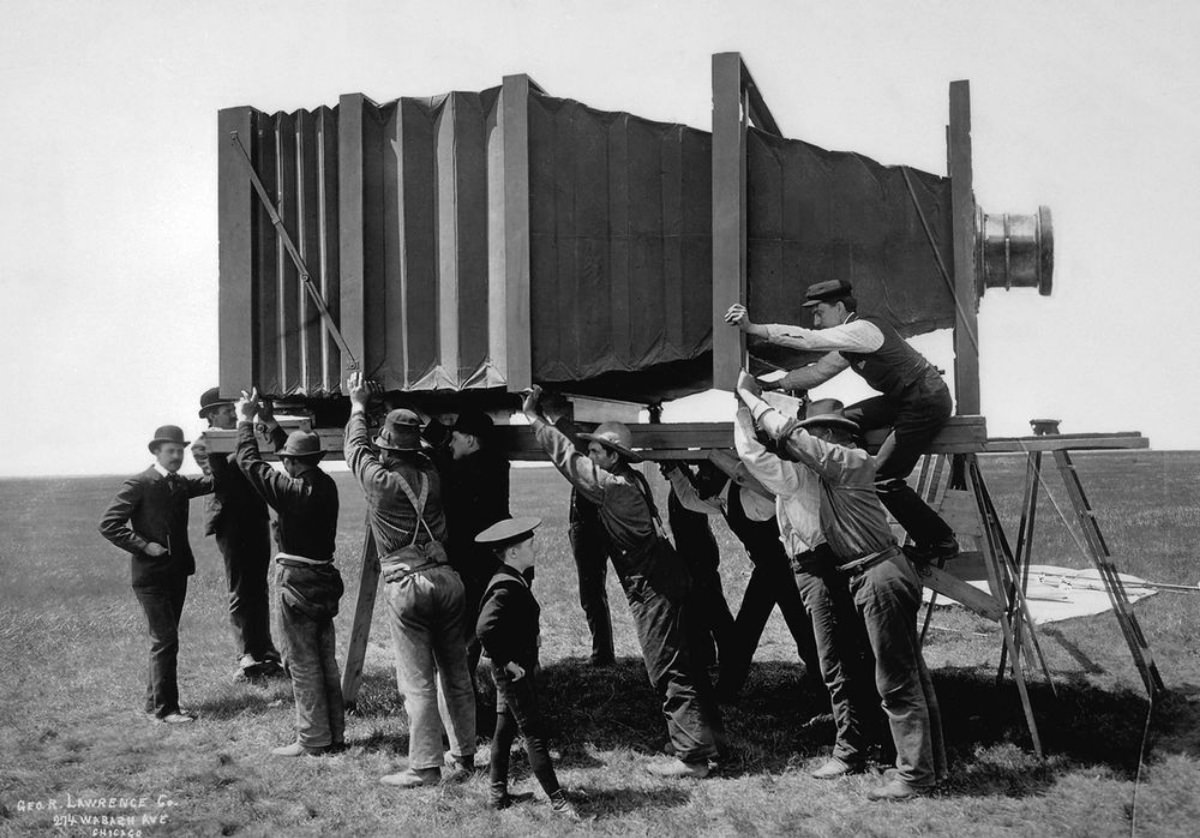
Steel braces, a billowing bellows, and a lens like a small cannon announce that this is no ordinary camera. A team of men crowds around the wooden frame, lifting and steadying the giant apparatus on open ground, while a suited observer stands back as if to underscore the experiment’s seriousness. The scene reads like a snapshot of industrial confidence—photography scaled up until it required manpower, carpentry, and nerve.
The title’s promise of a “Mammoth Camera” points to a moment around 1900 when inventors and showmen alike chased superlatives, from world’s fairs to railroad publicity. To make the world’s largest photograph, the mechanics had to be oversized too: an enormous plate, a rigid platform, and a carefully controlled exposure that left no room for wobble or mishap. Looking closely at the men’s poses—hands braced, shoulders pressed in—you can almost feel the weight of the equipment and the precision needed to coax an image from it.
Pairing this contraption with “the handsomest train” hints at the era’s fascination with speed, modern design, and the railroad as a symbol of progress worth memorializing in record-breaking scale. For readers searching the history of photography inventions, early large-format cameras, or railroad-era engineering, this photograph offers a vivid bridge between craft and spectacle. It reminds us that innovation was often a public performance, and that even a single exposure could be treated as an event worthy of a crew.