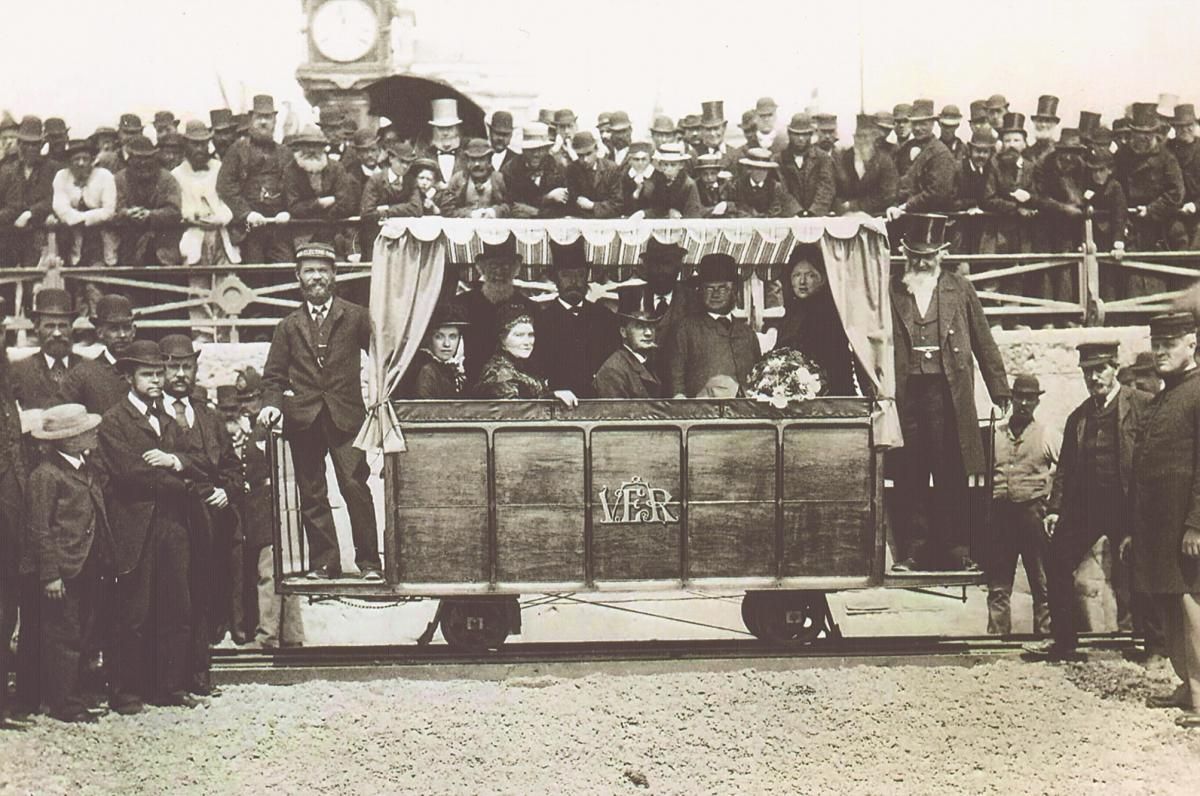
Crowds in stiff hats and dark coats press in as a curious little carriage pauses on its rails, dressed up with curtains like a seaside salon. Inside, well-to-do passengers pose formally, while officials and onlookers cluster around the platform to witness a novelty that felt both modern and slightly unbelievable. The carriage side bears the letters “V.E.R.,” a small detail that hints at the proud branding and public spectacle surrounding this experiment in transport.
Brighton’s “Daddy Long-Legs” Railway became famous for its strange solution to a practical problem: how to run an electric train along the shoreline where waves, tides, and shifting beach conditions made ordinary track a headache. Rather than hugging the promenade like a typical tram, the concept relied on an elevated vehicle carried on long supporting legs, turning the seafront into a stage for engineering bravado. Even in a still photo, the mixture of elegance, machinery, and seaside grit makes it clear why this invention has remained a talking point in British transport history.
For readers interested in Victorian-era inventions, early electric railways, and Brighton history, this image offers a vivid doorway into the era’s optimism about technology. The heavy crowding suggests a launch-day atmosphere—part civic event, part entertainment—where progress was something you could literally stand beside and stare at. Strange, ambitious, and unmistakably of its time, the Daddy Long-Legs Railway remains one of the most memorable examples of how the late 19th century reimagined travel by the sea.