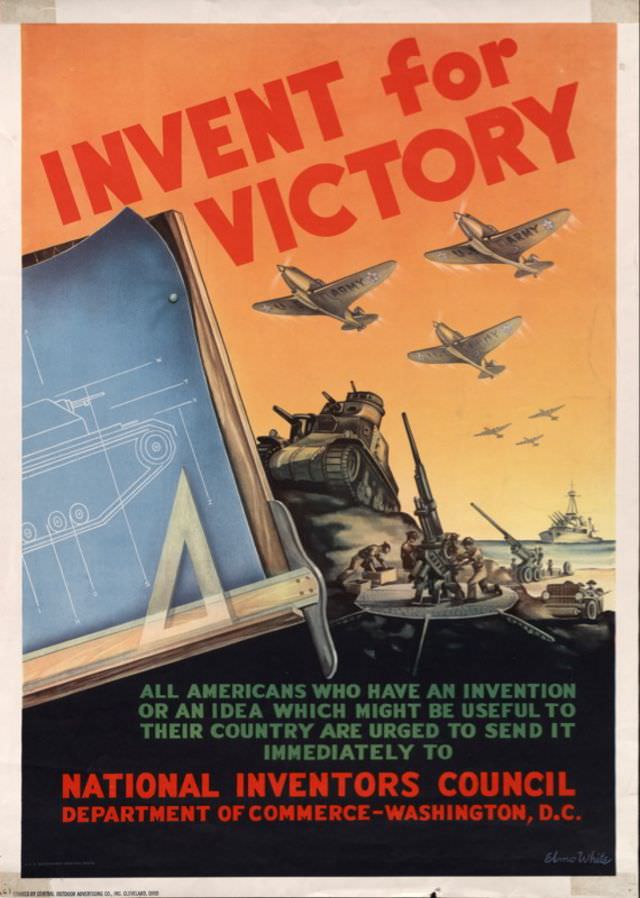
Bold lettering—“INVENT for VICTORY”—dominates the sky above a surge of wartime imagery, turning a simple slogan into a marching order. A drafting board fills the foreground with blueprint lines and a prominent “A,” a nod to patents and applied engineering, while aircraft streak across the background and armor and naval power press forward below. The composition links the quiet work of design to the roar of the battlefield, suggesting that the war could be fought as much with pencils and prototypes as with guns.
At the bottom, the call to action is unmistakably civic and urgent: Americans with an invention or useful idea are urged to send it “immediately” to the National Inventors Council, Department of Commerce, Washington, D.C. That detail anchors the poster in the machinery of home-front mobilization, when government agencies sought to harness private ingenuity for military needs. It’s propaganda with a practical pathway—less about cheering from the sidelines, more about recruiting minds, workshops, and tinkerers into a national project.
Seen today, this WWII propaganda poster doubles as a snapshot of faith in innovation itself, celebrating inventors as participants in victory. The warm gradient of the background, the confident typography, and the cascading scenes of modern warfare create a persuasive story: ideas become machines, and machines decide outcomes. For readers interested in World War II history, American propaganda art, and the history of invention, it’s an evocative reminder of how creativity was framed as a patriotic duty.