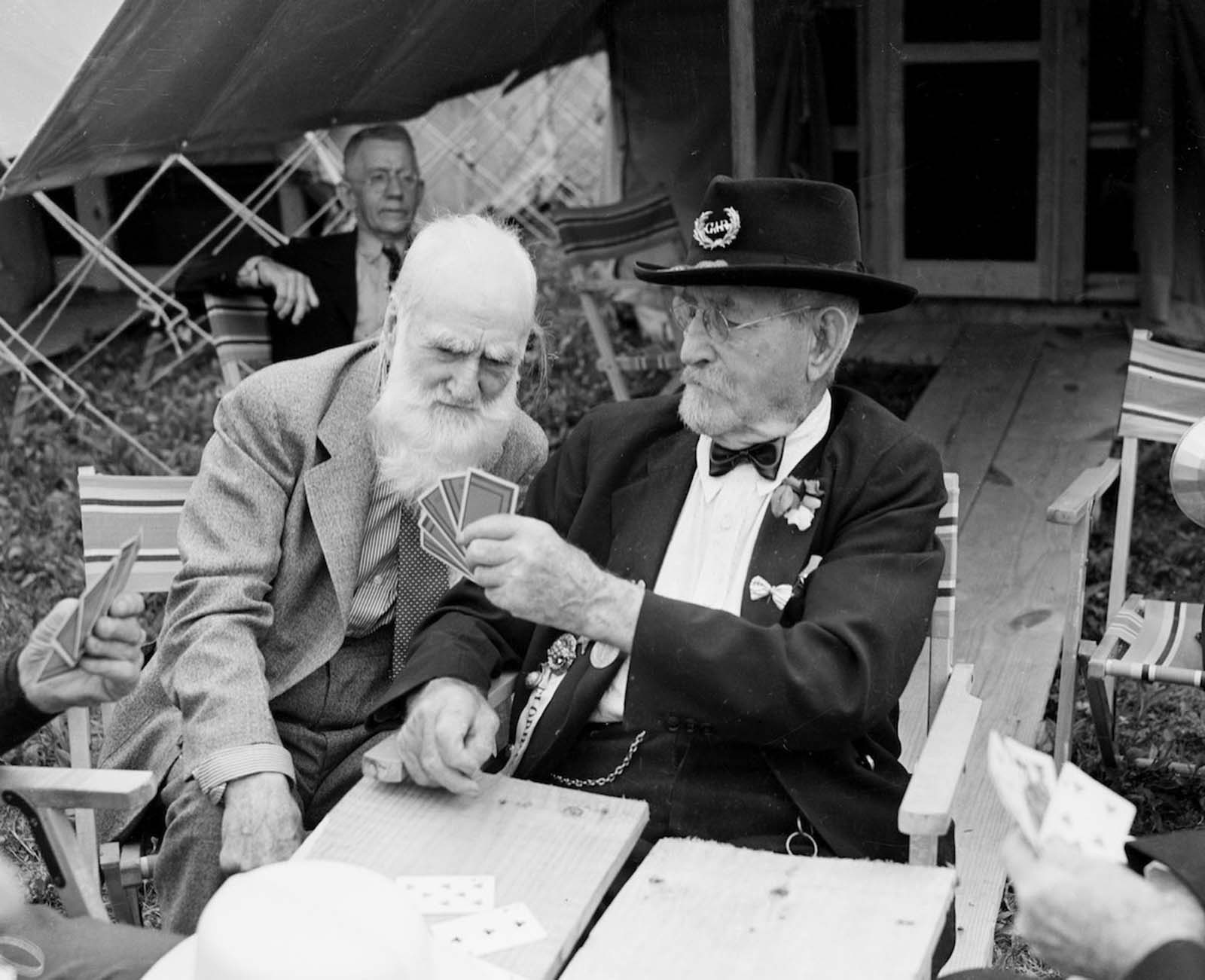
Under a canvas awning, a small circle of elderly Civil War veterans settles into the easy ritual of a card game, their attention fixed on a modest table and the hands they hold. One man, marked by a long white beard and heavy brows, leans in with a serious, almost guarded concentration, while another—wearing a dark hat adorned with a “G.A.R.” insignia—studies his cards as if weighing more than the next trick. Folding chairs, a simple porch, and the casual sprawl of camp furnishings create a scene that feels both ordinary and quietly monumental.
The details invite a closer look at how memory was worn in 1930: in lapels pinned with small emblems, in formal jackets brought out for public gatherings, and in the practiced camaraderie of men who had outlived their war by decades. The Grand Army of the Republic badge hints at veterans’ organizations that kept reunions, relief efforts, and shared identity alive long after the fighting ended. Even without a named location, the setting suggests a reunion or encampment atmosphere—temporary, communal, and built around conversation as much as commemoration.
What makes this historical photo resonate is its gentle contrast between the epic scale of the American Civil War and the intimate scale of aging hands, creased faces, and a few well-used playing cards. The game becomes a kind of social shorthand: companionship without speeches, competition without bitterness, and a way to pass time among those who understood the same distant chapters. For anyone searching Civil War veterans in 1930, GAR reunion imagery, or everyday life in early 20th-century America, this moment offers a human, unguarded window into how the last survivors carried their past into the present.