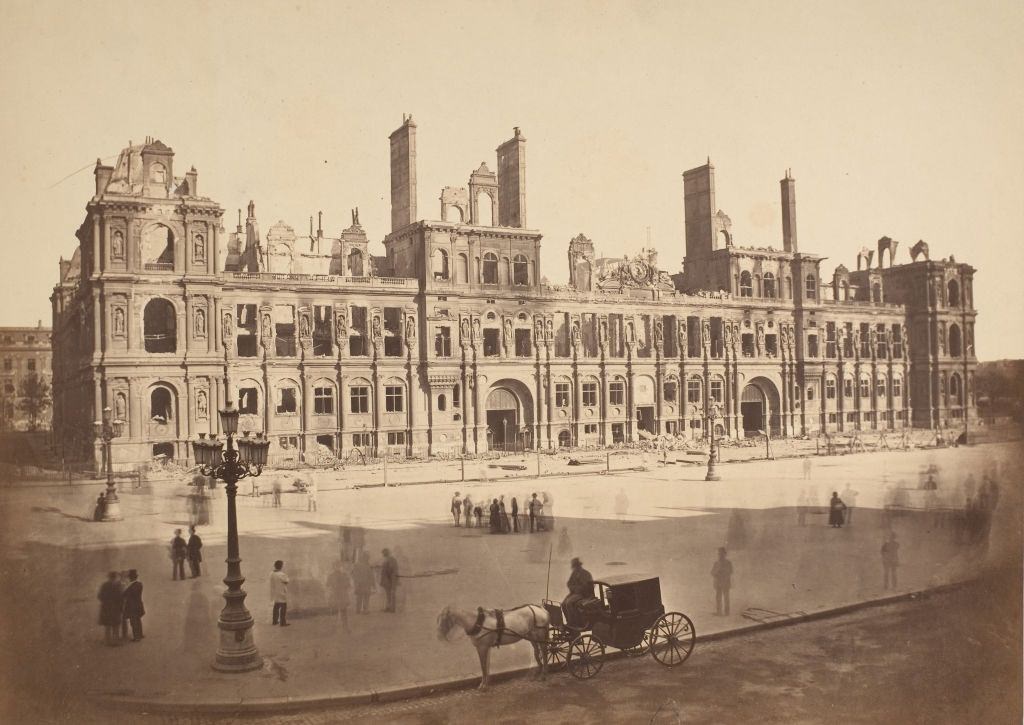
Across the open square, the Hötel De Ville stands stripped to its shell, a long façade pierced by empty windows and crowned by jagged rooflines where the upper stories have vanished. Tall chimneys and fractured walls rise like monuments of soot and stone, while piles of rubble trace the building’s base. The photograph’s calm, steady framing makes the damage feel all the more stark, turning civic grandeur into a record of ruin.
In the foreground, everyday movement returns cautiously: small groups of onlookers pause at a distance, and a horse-drawn carriage waits near the edge of the frame. A lamppost anchors the scene and hints at the prewar city’s familiar street order, now set against a municipal landmark battered by civil conflict. The contrast between the vast, broken architecture and the tiny figures below emphasizes how quickly public space can change when a civil war reaches the heart of a capital.
Linked to the Paris Commune of 1871, this image works as both documentation and warning, capturing the aftermath rather than the clash itself. It invites closer reading of details—collapsed cornices, missing roof sections, and the uneven silhouettes along the skyline—that speak to fire, demolition, and the hard work of rebuilding. For readers searching for Paris Commune history, 19th-century France, or the destruction and reconstruction of the Hötel De Ville, the photo offers a haunting, SEO-friendly window into a city remade by revolution and repression.