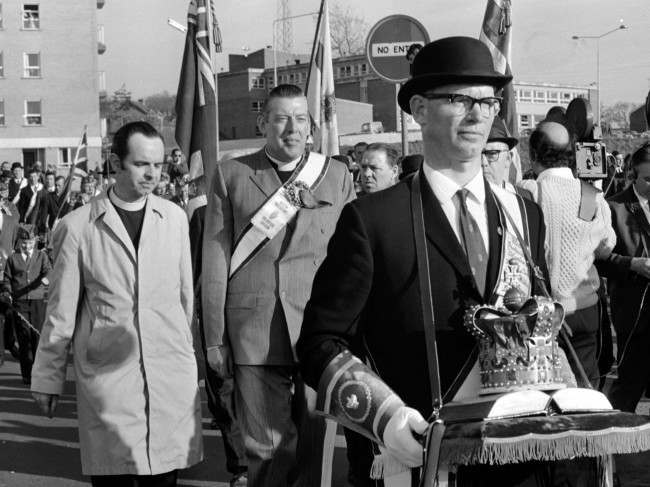
Easter Saturday in 1971 brings a charged procession through Armagh, Northern Ireland, as Reverend Ian Paisley walks behind a crown bearer at the head of the Protestant Easter March. Banners and flags rise above the crowd, formal dress and clerical collars lending the moment a ceremonial gravity even as the street scene hints at confrontation. The crown—carried like a religious and political emblem—anchors the frame, turning the march into a statement of identity as much as devotion.
Behind the leading figures, the march stretches back into the city, packed with participants moving in step while onlookers and press edge close. A road sign reading “NO ENTRY” sits above the procession like an accidental caption, underscoring the restrictions, boundaries, and contested space that defined public life during the Troubles. The mix of everyday urban buildings with parade regalia captures how ordinary streets became stages for competing loyalties.
British troops stand guard along the route, a stark reminder that parades and demonstrations in Northern Ireland were rarely merely symbolic in this era. The title’s details—Armagh, the Protestant Easter March, and April 10, 1971—place the photograph firmly within a period of civil conflict when security presence, religious affiliation, and political leadership were inseparable in public view. For readers searching Northern Ireland history, Ian Paisley, Armagh marches, or Easter demonstrations during the Troubles, this image offers a vivid snapshot of tension held in formal order.