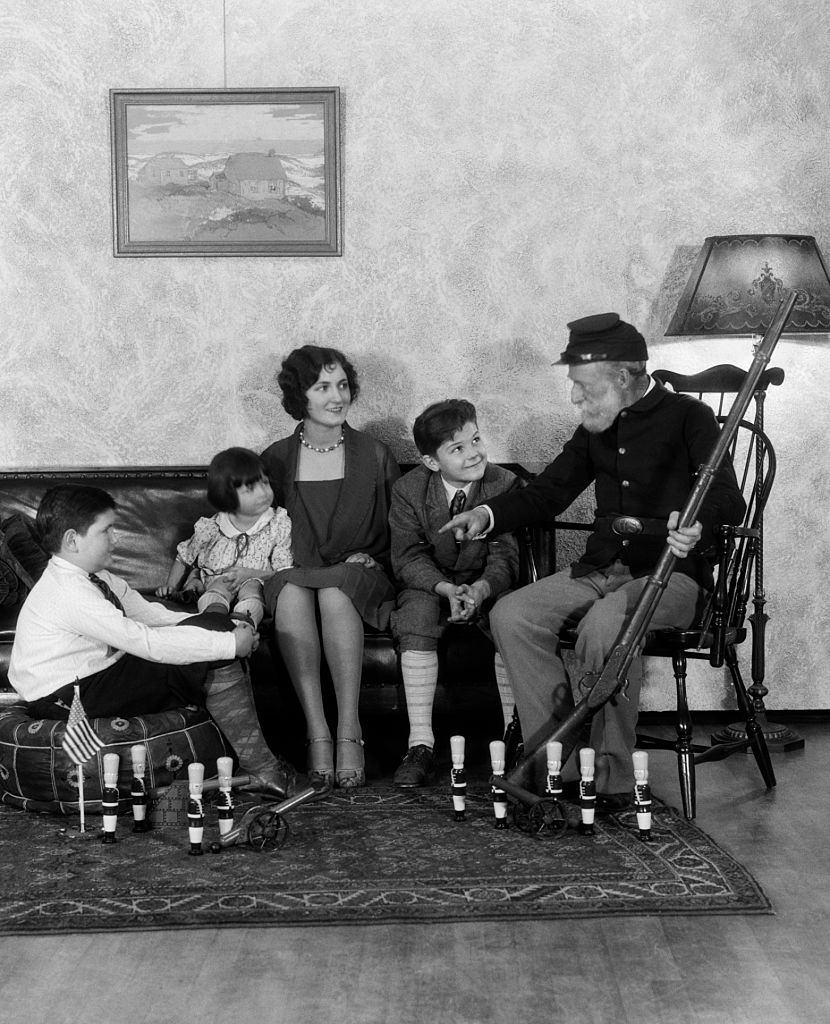
In a quiet 1930s living room, a Civil War veteran sits in a rocking chair, leaning forward as he spins a story for the children gathered around him. A long rifle rests across his lap, not merely a prop but a tangible link to a conflict the younger generation knows only through family memory. The boy nearest him listens with a half-smile and wide eyes, as if trying to picture battlefields from a tale told at arm’s length.
On the sofa, an adult woman—likely a parent—watches the exchange, her posture calm and attentive, bridging the gap between the elder’s past and the children’s present. The setting feels unmistakably domestic: framed artwork on the wall, a shaded lamp, and the everyday comforts of home. It’s the kind of scene that turns history from a chapter in a book into a personal inheritance passed down one conversation at a time.
Details on the floor add their own layer of meaning: toy bowling pins lined up on a rug, a small wagon, and a miniature American flag tucked beside a child’s knee. Play and remembrance share the same space, suggesting how children absorb the nation’s Civil War legacy while still living in the rhythms of ordinary family life. For anyone researching 1930s Americana, home-front storytelling, or intergenerational memory, this photograph offers a vivid glimpse of how the past stayed present in everyday households.