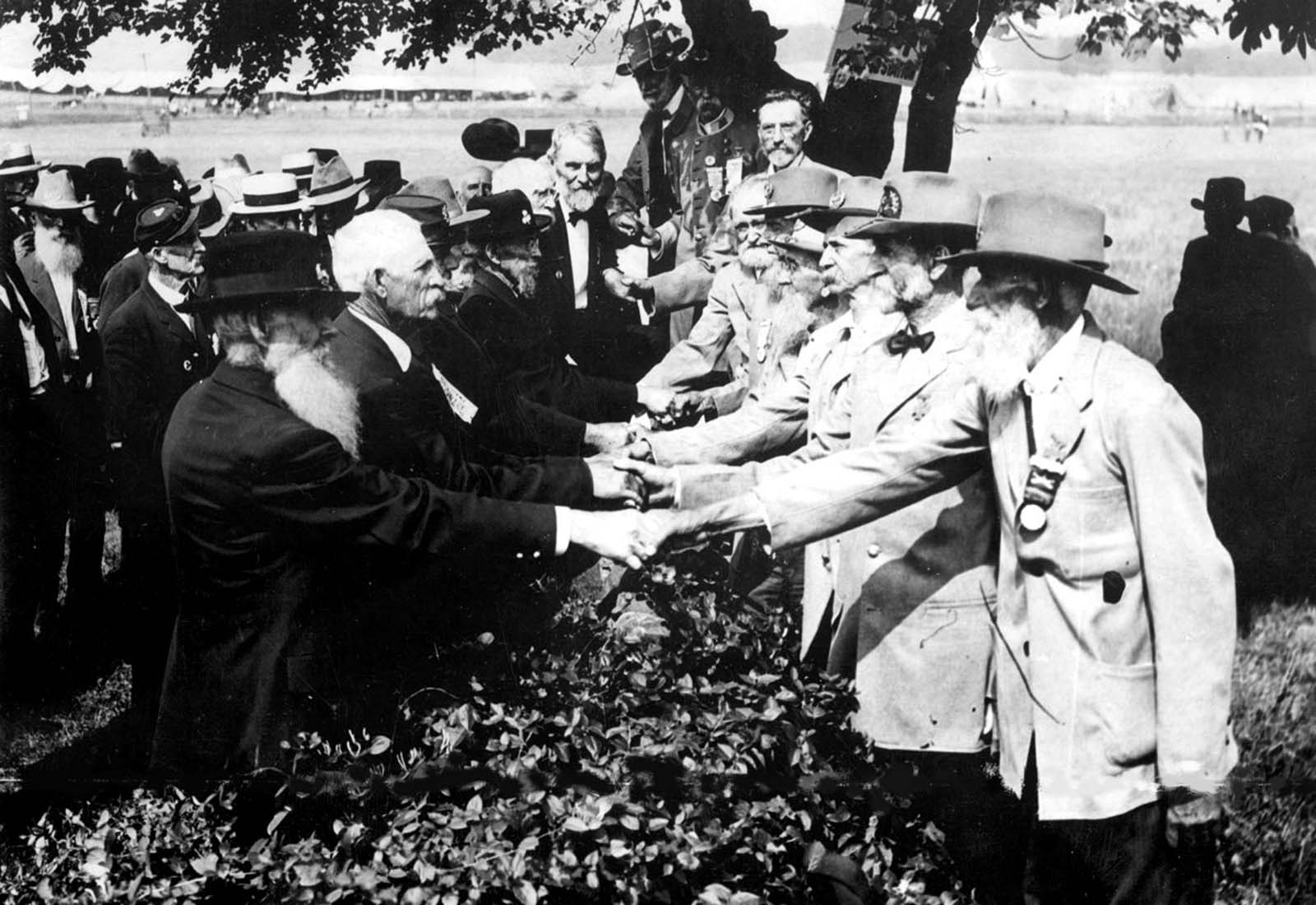
Beneath a canopy of leaves on the Gettysburg battlefield, a line of elderly men leans forward to clasp hands across a narrow strip of shrubs, turning a former killing ground into a meeting place. Their long beards, brimmed hats, and weathered faces speak to the passage of time, while small badges and medals pinned to lapels hint at hard service remembered. Onlookers crowd close behind, forming a living backdrop that makes the handshake feel both intimate and public, a moment staged for memory as much as for reunion.
Taken in Gettysburg, Pennsylvania, during the 50th anniversary commemoration in 1913, the scene places Union veterans on the left and Confederate veterans on the right, their arms reaching out in a chain of grips. The composition draws the eye along the row of extended hands, suggesting a deliberate ritual of reconciliation enacted by men who had once faced each other in battle. In the distance, open fields and gathering tents evoke the scale of the anniversary events, when thousands returned to walk familiar ground and recount what they had survived.
Few Civil War images carry such a clear emblem of postwar reunion, yet the photograph also invites harder questions about what “reunion” meant, and whose stories were centered in these public remembrances. As a historical artifact, it captures the early 20th-century shaping of Civil War memory—solemn, sentimental, and increasingly focused on shared soldierly experience. For readers searching Gettysburg anniversary 1913, Civil War veterans, or Union and Confederate reunion photos, this handshake remains a powerful doorway into the era’s politics of remembrance and the enduring weight of the battle of Gettysburg.