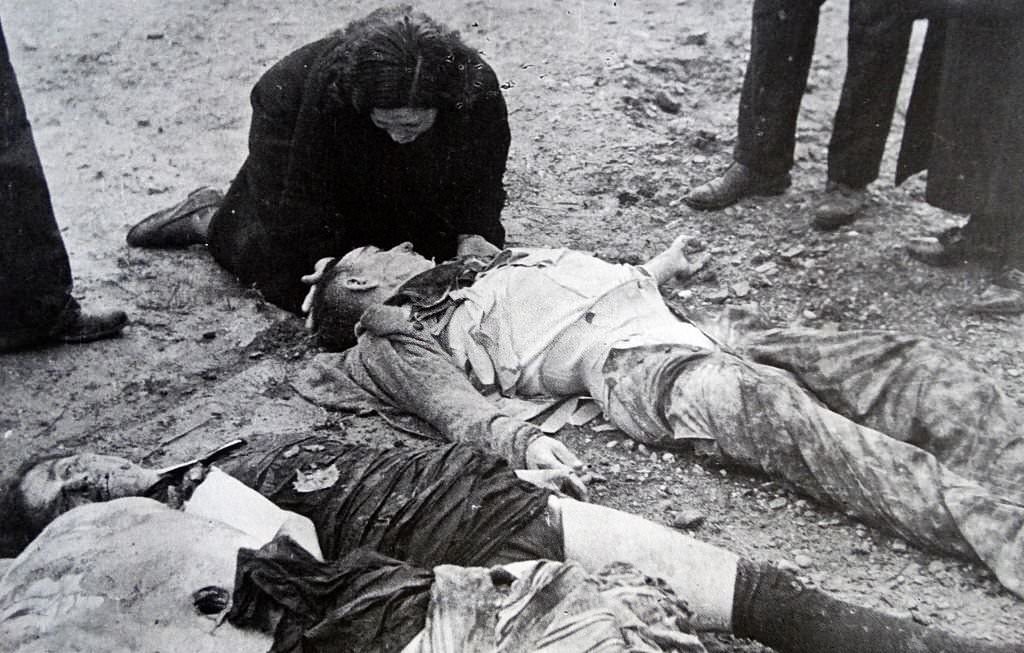
Grief is the first thing that meets the eye: a woman kneels in the dirt, bending over a lifeless body while other onlookers stand just out of frame, their legs and shoes a stark reminder of a crowd gathered in shock. The ground is rough and littered, and the clothing of the dead and the living looks heavy with dust, suggesting the immediate aftermath of a violent strike rather than a composed wartime scene. Without needing any caption, the photograph communicates the intimate scale of catastrophe—how aerial warfare could drop suddenly into ordinary streets and turn them into places of mourning.
Set against the post title, the moment connects directly to the November 2, 1937 Condor Legion attack on Lleida (Lerida) during the Spanish Civil War, when German forces supporting Franco’s side carried out bombing raids that terrorized civilian centers. Images like this one became part of the wider story of the conflict: the testing of air power, the targeting of cities, and the growing realization across Europe that modern war would no longer keep “front lines” separate from daily life. The bodies in the foreground and the quiet, stunned posture of the survivor above them underscore that the victims were not anonymous statistics but neighbors, family members, and passersby.
For readers searching Spanish Civil War history, Lleida 1937, or Condor Legion bombing, this photograph serves as a blunt visual document of what those terms meant on the ground. It also echoes a broader pattern of the war, in which bombing raids were used not only to destroy infrastructure but to break morale through fear and grief. The scene invites careful reflection on how such attacks were recorded, remembered, and later used to understand the human cost of political violence in Spain.