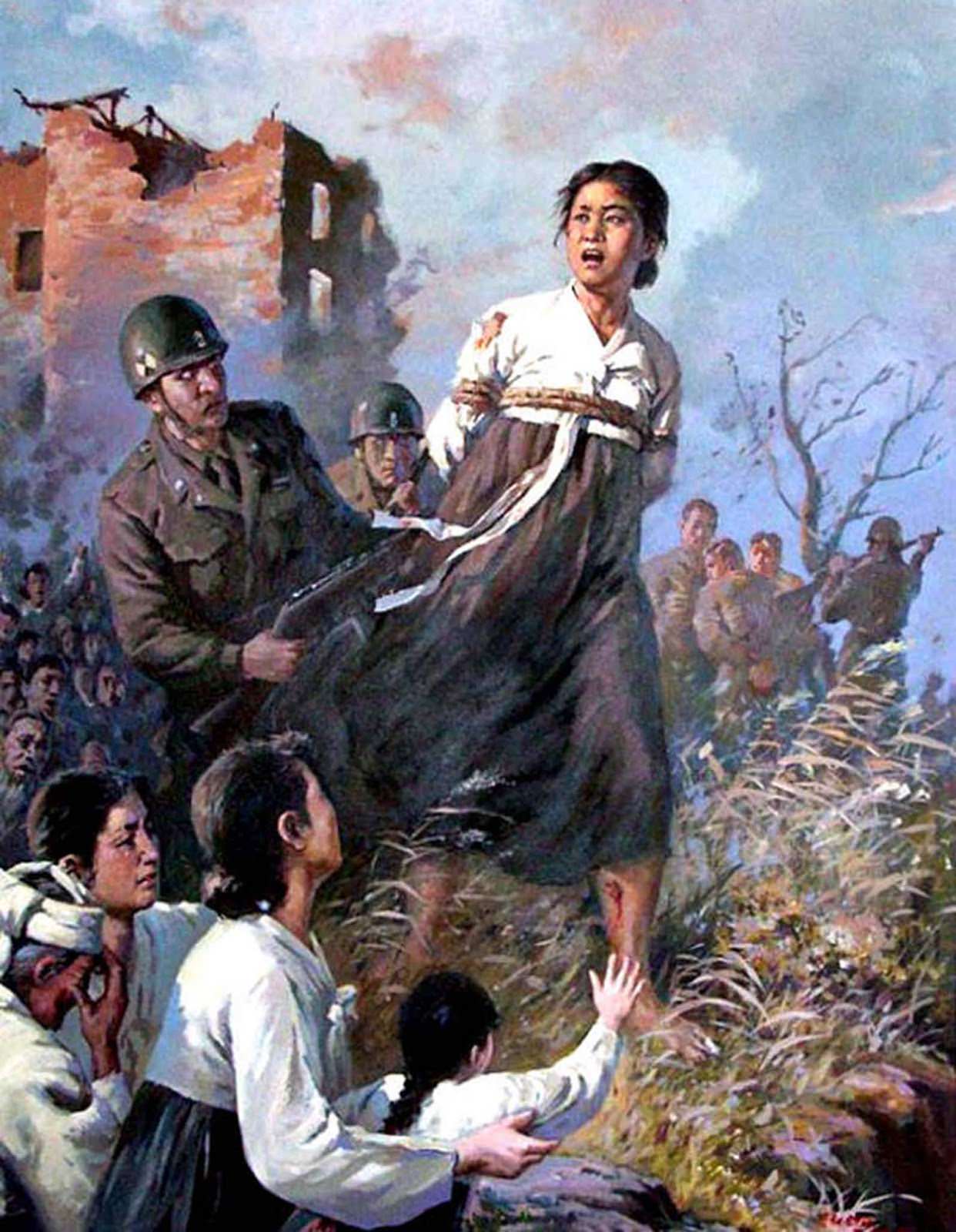
Tension and terror dominate this wartime scene: uniformed soldiers in helmets seize a Korean woman whose hands are bound behind her back, her face turned upward in shock as she is forced forward. Civilians cluster in the foreground—women and a child reaching out—while smoke and haze roll across a landscape of broken walls and skeletal trees. The composition feels less like a candid snapshot and more like a staged, propagandistic artwork, using dramatic lighting and motion to pull the viewer into the moment.
Behind the central figure, armed men form a hard line that contrasts with the helplessness of those watching, their gestures and stances suggesting threat and control. The woman’s traditional clothing, the crowd’s anguished expressions, and the ruined building in the background work together to signal a Korean setting without providing clear identifiers such as a specific town or date. As suggested by the post title, the imagery frames extreme violence and punishment, emphasizing fear, public spectacle, and the vulnerability of noncombatants during conflict.
For readers researching Korean War-era imagery, US military depictions, or the ways atrocity narratives are visualized, this piece is a stark example of how history can be mediated through illustration. It invites questions about source, intent, and circulation: who produced it, what audience it sought to convince, and what realities it claims to represent. Seen today, the scene functions as a grim prompt for remembrance and critical reading, reminding us that “historical photos” online are sometimes artworks that shape memory as powerfully as any camera ever could.