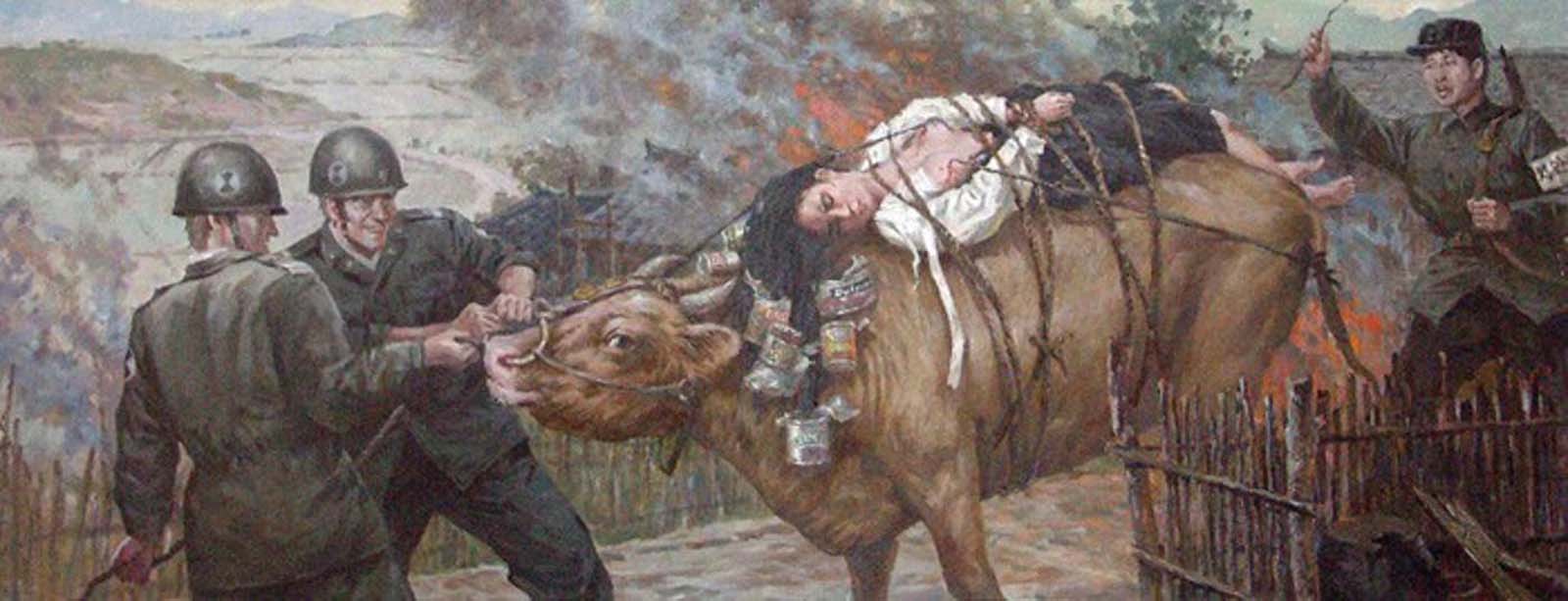
Unease settles in immediately: a limp body is bound across the back of a large animal and driven forward, while uniformed men close in from both sides. One grips the lead with strained determination, another watches from behind, and a third—arm raised—seems to direct the grim procession. Smoke and fire churn in the distance, turning the landscape into a threatening haze and framing the scene as something born of conflict rather than ordinary street life.
The composition leans into spectacle and coercion, using the animal’s lowered head and the tight web of ropes to underline control and humiliation. The crowd is not shown, yet the implied audience is everywhere—suggested by the forced march itself, by the fencing at the edge of the road, and by the theatrical gesture of the man shouting or signaling. Details like the canisters hanging at the animal’s side and the rough terrain add a documentary texture, even as the image feels like an artwork intended to persuade as much as to record.
For readers interested in historical imagery, wartime propaganda, and the visual language of public punishment, this post invites careful looking and difficult questions. What purpose does such a display serve—intimidation, warning, revenge, or a claim of victory—and how do artists and photographers make brutality legible to an audience? Placed under the broad umbrella of “Artworks,” the piece stands as a stark reminder that images can be weapons, shaping memory and emotion long after the smoke has cleared.