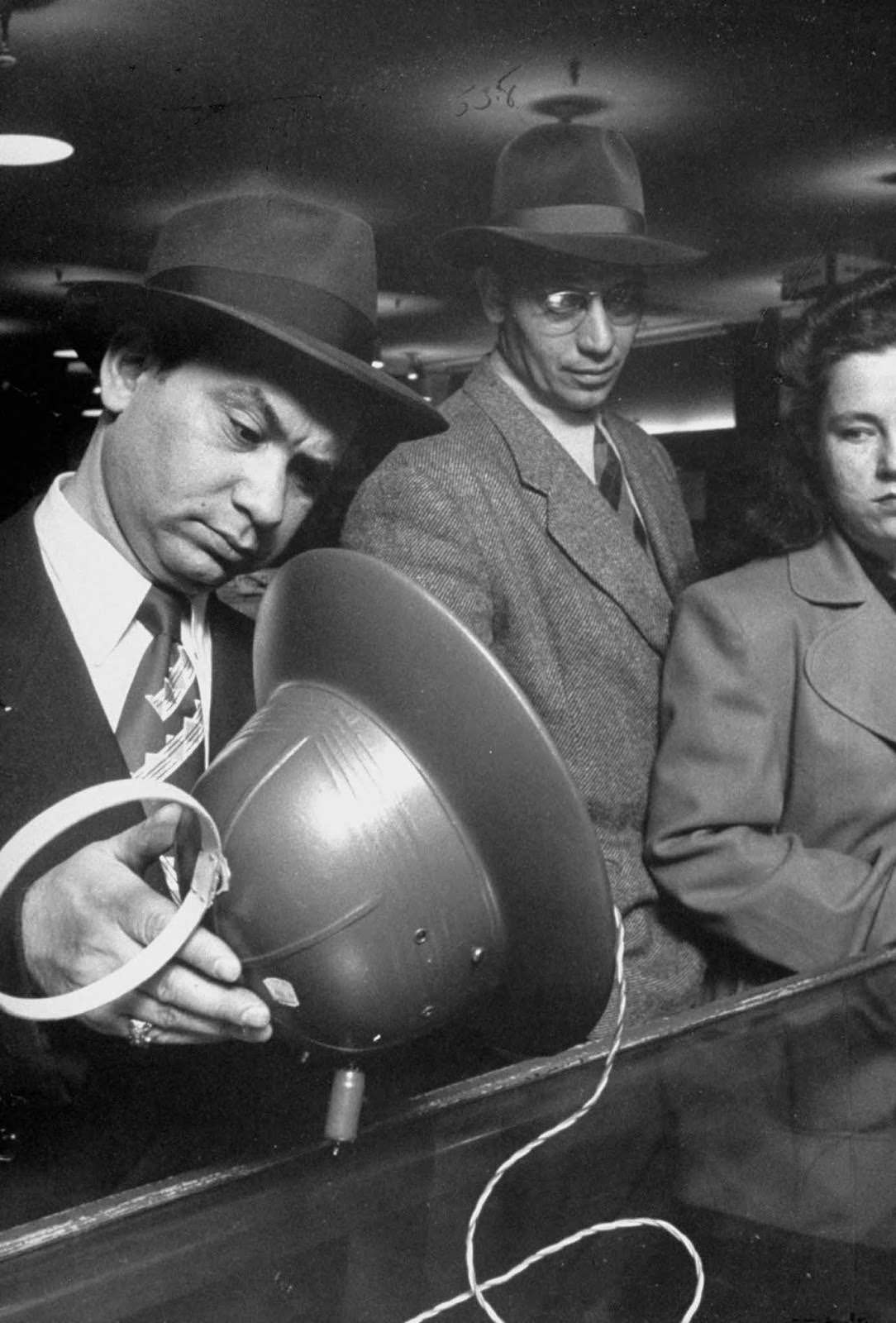
Under bright indoor lights, a small crowd leans in as a hat-wearing demonstrator turns a smooth, rounded radio-like housing in his hands, the device’s curved shell and trailing cord hinting at a prototype meant to be handled and inspected. Faces are intent and skeptical in the way only a live technology demo can provoke, with onlookers studying the object’s surface for clues about how it works. The setting feels like a public showcase—part sales pitch, part science lesson—where the promise of modern communication is made tangible.
The title’s focus on vacuum tube technology fits the era’s design reality: before transistors shrank electronics, radios often needed glass tubes, heat, and space, and makers sometimes treated those components as features rather than inconveniences. Even when the tubes themselves aren’t visible in this particular angle, the heavy, purposeful casing suggests a machine built around components that demanded airflow and careful layout. It’s a reminder that “sleek” once meant something different—streamlined on the outside, but complex and glowing within.
Invention culture thrives on moments like this, when a new radio concept meets the public eye and must win trust through craftsmanship, practicality, and performance. For readers interested in the history of radio design, vacuum tubes, and early consumer electronics, the photograph captures the human side of engineering: curiosity, scrutiny, and the thrill of hearing something new come alive. Look closely and you can almost feel the hum of a working set, poised between laboratory ingenuity and living-room adoption.