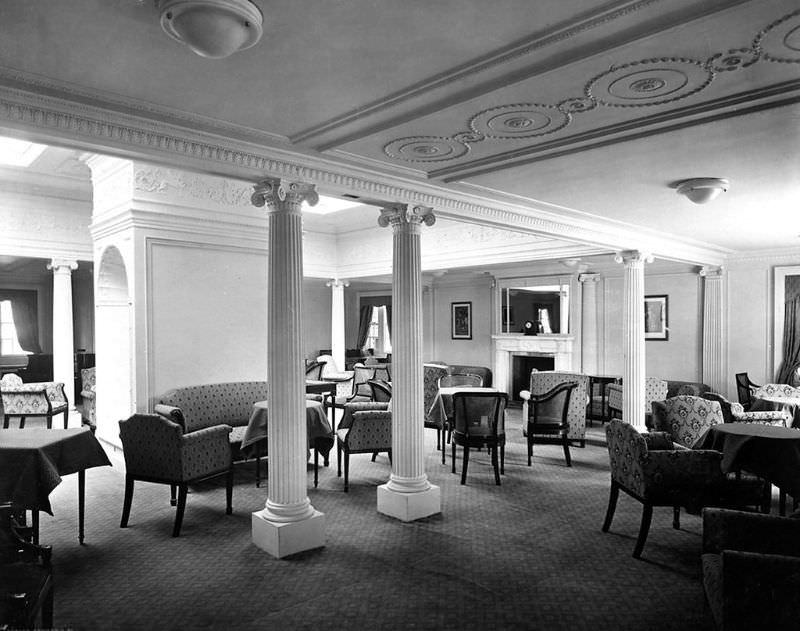
Stepping into Aquitania’s 2nd Class Drawing Room on the Bridge Deck (B Deck), you’re met by a carefully staged harmony of comfort and refinement. Classical columns march across the space, supporting a ceiling dressed with decorative plasterwork and circular motifs, while upholstered chairs and settees gather around small tables as if awaiting quiet conversation. Light spills in from curtained windows along the starboard side, softening the room’s symmetry and giving the furnishings a lived-in warmth.
The view draws the eye forward toward the fireplace at the far end, a focal point that anchors the room like a private parlor transplanted to sea. Framed pictures punctuate the walls, and the seating is arranged to encourage reading, visiting, and lingering—an atmosphere that feels deliberately domestic despite the shipboard setting. Even without passengers present, the layout suggests routines of tea, letters, and evenings spent in understated company, far from the bustle of decks and corridors.
For anyone searching naval history, ocean liner interiors, or the social world of early 20th-century travel, this May 1914 glimpse of Aquitania offers rich detail. It reveals how “second class” could still mean tasteful design, careful craftsmanship, and an experience shaped by etiquette as much as engineering. The post title’s precise vantage—starboard side, looking toward the forward fireplace—turns the photograph into a small guided tour, preserving the feel of a transatlantic crossing just before the world changed.