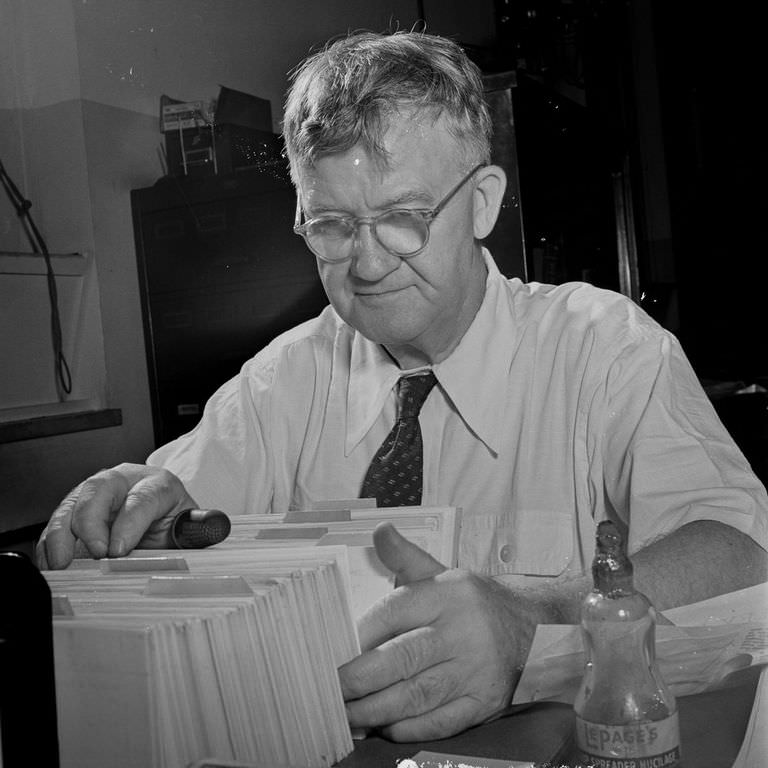
Tommy Bracken leans over a crowded desk, sleeves rolled and tie still neatly in place, as if the day’s work has no room for ceremony. His attention is fixed on a thick line of index cards—an old-fashioned records system that turns grief, procedure, and identification into orderly paper trails. The close framing brings you into his workspace, where concentration is the defining expression and every file suggests a story handled with care.
Behind the calm posture sits the weight of a long career, echoed in the post title’s note that he was a 51-year employee and head of the morgue. The setting feels administrative rather than sensational: cabinets in the background, a practical lamp, and the subtle clutter of a working office rather than a staged scene. Even small details—the worn edges of card stock, the utilitarian glass bottle on the desk—hint at routines built over decades in a job that demanded steadiness.
For readers drawn to social history and the behind-the-scenes labor of public institutions, this historical photo offers a rare look at the paperwork and discipline that supported morgue operations. It’s a portrait of professionalism in an era before digital databases, when information lived in drawers and was retrieved by hand, one card at a time. As an SEO-friendly window into archival record-keeping, workplace culture, and the human side of long service, the image invites reflection on how essential roles like Bracken’s quietly shaped the everyday functioning of a community.