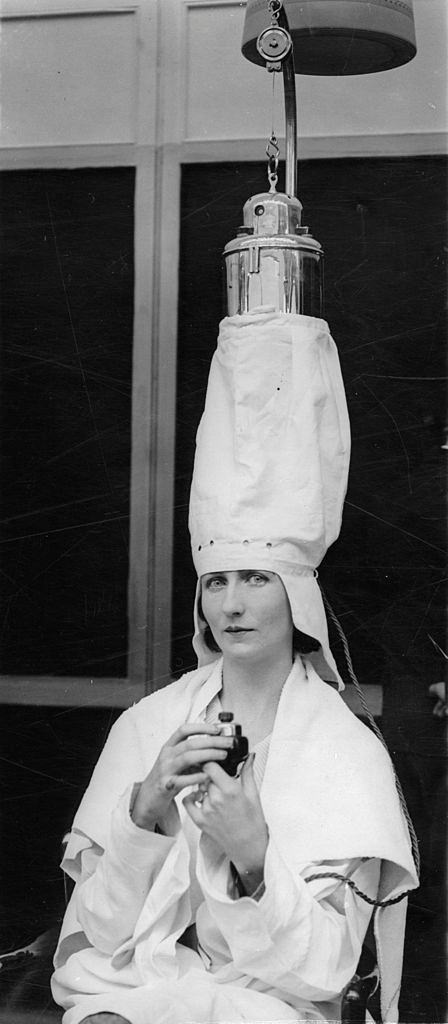
Suspended from above like a piece of salon machinery turned laboratory apparatus, the hair dryer in this photo looks more like a helmeted experiment than a beauty routine. A fabric hood wraps tightly around the sitter’s head, tethered to a metal canister and pulley system overhead, hinting at early attempts to harness controlled heat and airflow. The woman’s calm, almost unimpressed gaze underscores the odd contrast between comfort and contraption that defined many 20th-century inventions.
Before handheld blow dryers became a bathroom staple, drying hair often meant sitting still beneath bulky devices designed for speed, uniform results, and the promise of modern efficiency. Hooded and hanging models like this one were part fashion technology, part industrial design—built to deliver warmth through tubes and chambers, with safety and convenience still very much in development. The setup reveals how beauty culture and electrification evolved together, turning everyday grooming into a showcase for engineering.
For anyone curious about the bizarre history of hair dryer models, images like this offer more than novelty—they document changing ideas about femininity, leisure, and “scientific” progress in the home and salon. The stark materials, the overhead rigging, and the tightly cinched hood make the device feel simultaneously practical and theatrical, a reminder that innovation often arrives in awkward stages. Explore the rest of the post to see how these early designs paved the way for the streamlined hair dryers that eventually defined the late 20th century.