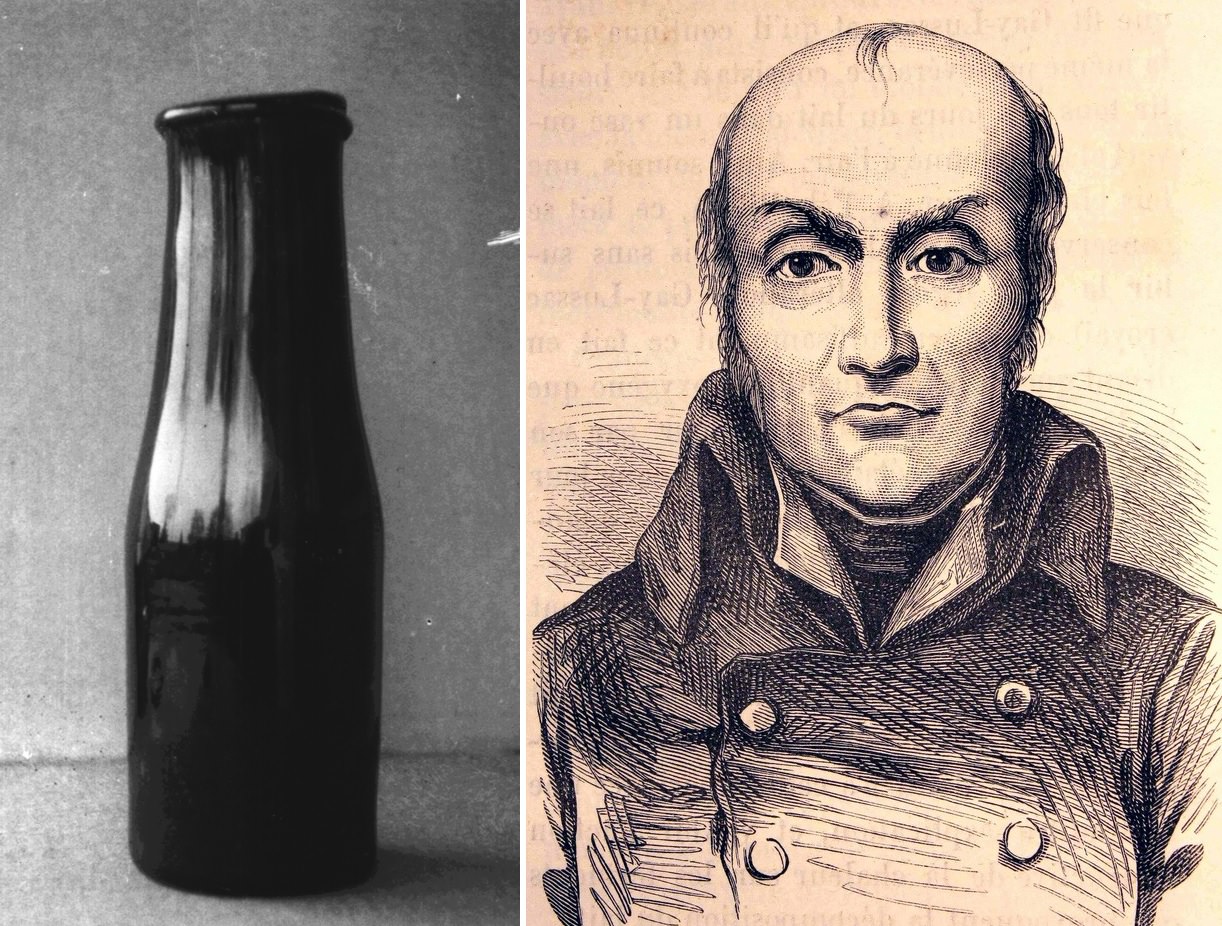
Appert’s breakthrough begins here with a deceptively simple pairing: a sealed container on the left and a period-style engraved portrait on the right. The dark, narrow bottle stands upright like a tool of the trade, its glossy surface catching light along the neck and shoulder, while the illustration evokes the early 19th-century world that was hungry for practical inventions. Together they point to the moment when food preservation shifted from kitchen improvisation to a repeatable, systematized method.
In 1810, Nicolas Appert’s work helped lay the groundwork for what we now call canning—preserving food by heating it in a closed vessel to keep spoilage at bay. Long before modern supermarkets and global supply chains, reliable preserved meals mattered for everyday households as well as long journeys where fresh provisions were scarce. The image’s focus on container and inventor underscores an essential truth of industrial history: new techniques often travel into society on the strength of humble objects.
For readers exploring the history of inventions, this post connects Appert’s early preservation experiments to the wider story of canned food and modern convenience. The stark contrast between the utilitarian bottle and the carefully rendered portrait invites a closer look at the craft, trial-and-error, and practical science behind early food storage. It’s a reminder that a single innovation in preservation can reshape diets, economies, and daily life for generations.