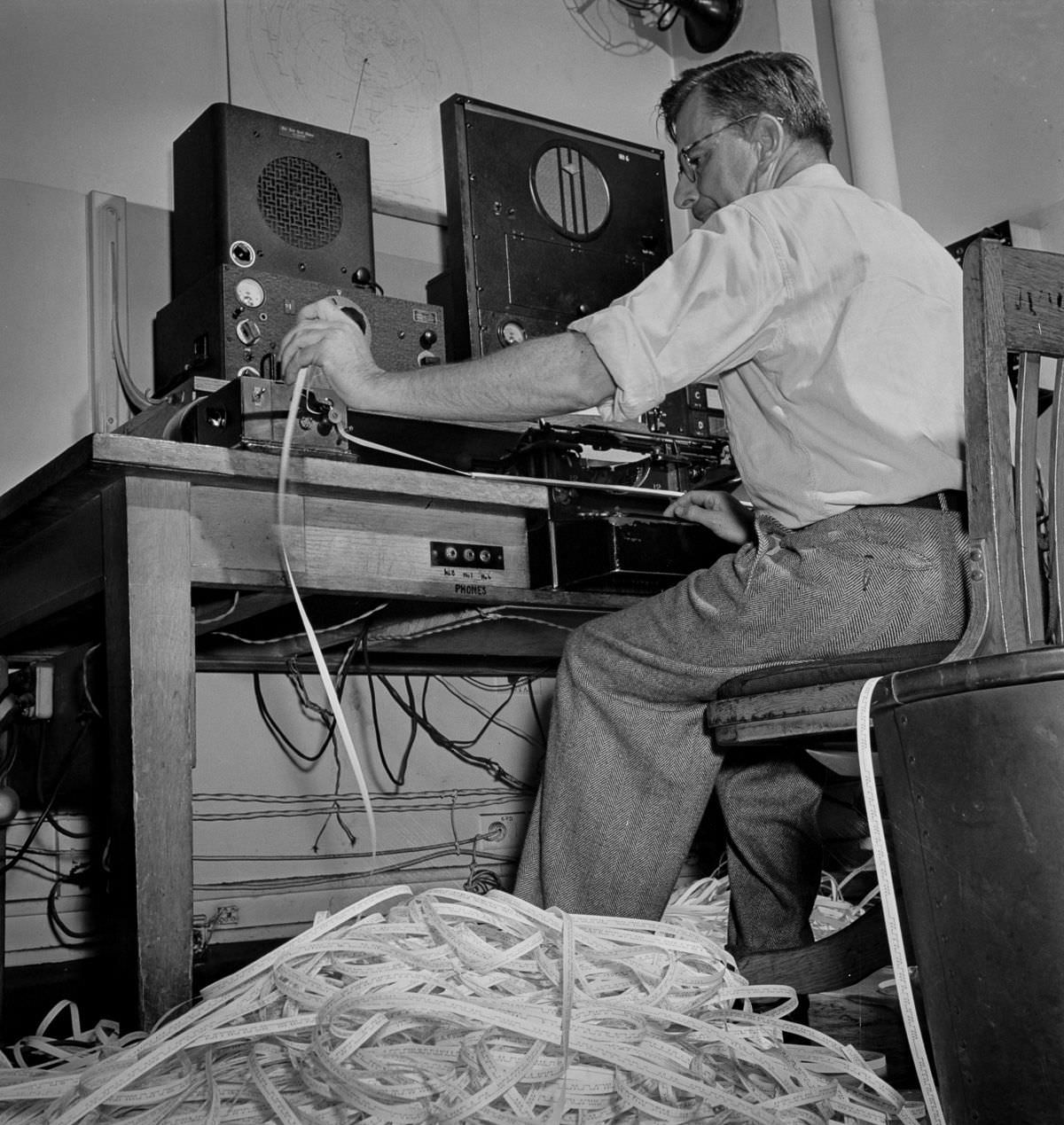
Bent toward a bank of radio receivers, a lone operator adjusts a dial with the careful touch of someone who knows that a fraction of a turn can change everything. Heavy cabinets of equipment dominate the desk, their gauges and speaker grilles hinting at the era’s cutting-edge communications technology. Wires snake beneath the tabletop, while the man’s focused posture and headset cord create a quiet sense of urgency—an office-bound front line where sound, not gunfire, carries the day’s battle.
Across the floor lies the real evidence of the work: long strips and piles of examined paper, marked by repetition and routine. Each broadcast monitored and each message checked had to be sorted against what “has already been covered in the last edition,” turning propaganda into data and noise into record. The scene reads like an early newsroom-meets-laboratory, where listening was only the first step and documentation was the weapon that made intelligence usable.
For readers drawn to World War II history, radio monitoring, and the evolution of information warfare, this photograph offers an intimate view of how broadcasts were tracked and interpreted in real time. It also speaks to the broader story of inventions and communications—how advances in radio hardware, transcription methods, and disciplined analysis shaped what officials and editors could report. Seen today, the clutter of paper and the humming machinery evoke a world where news traveled over the air, and vigilance meant staying tuned long after the public had turned the dial.