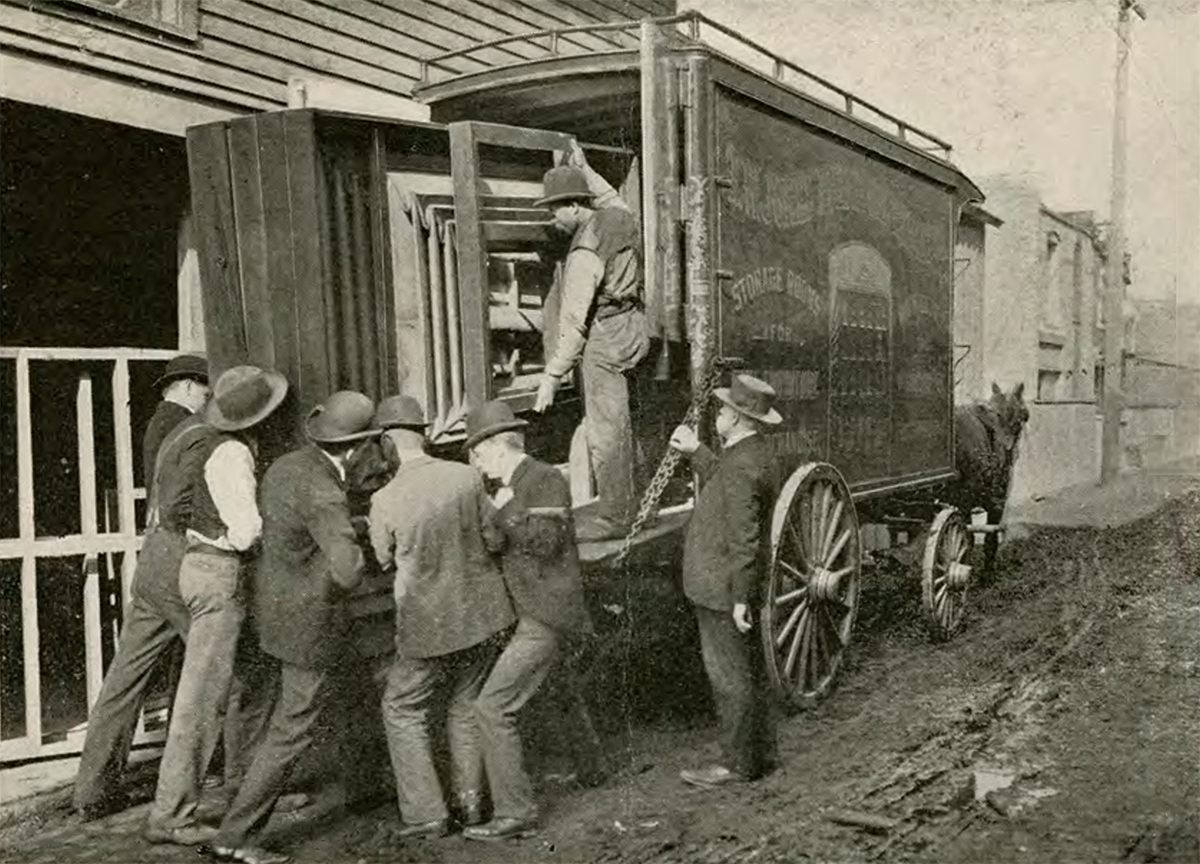
A muddy street, a tall-sided wagon, and a small crowd of men in hats gather around an open rear door as something bulky is eased into place. Inside the vehicle, a worker braces himself and guides a large wooden apparatus—more furniture than gadget—suggesting the sheer scale of early photographic equipment. The moment feels half logistics, half spectacle: progress arriving not with a click, but with a heave.
“Transporting the camera” hints at an era when making images demanded carpentry, muscle, and careful packing. Before compact bodies and roll film became commonplace, photographers often relied on oversized cameras, glass plates, and fragile accessories that had to be moved like valuable freight. The wagon itself functions as a mobile studio of sorts, built to protect precision instruments from bumps, weather, and the everyday chaos of the road.
For anyone interested in inventions and the history of photography, this scene offers a grounded reminder that technology is also infrastructure—containers, wheels, and teamwork. The clothing, the street surface, and the utilitarian design of the transport all speak to a working world where innovation traveled at the pace of horses and hand labor. It’s an evocative snapshot of how the camera didn’t just change what people could record; it changed what they had to build and organize to record it.