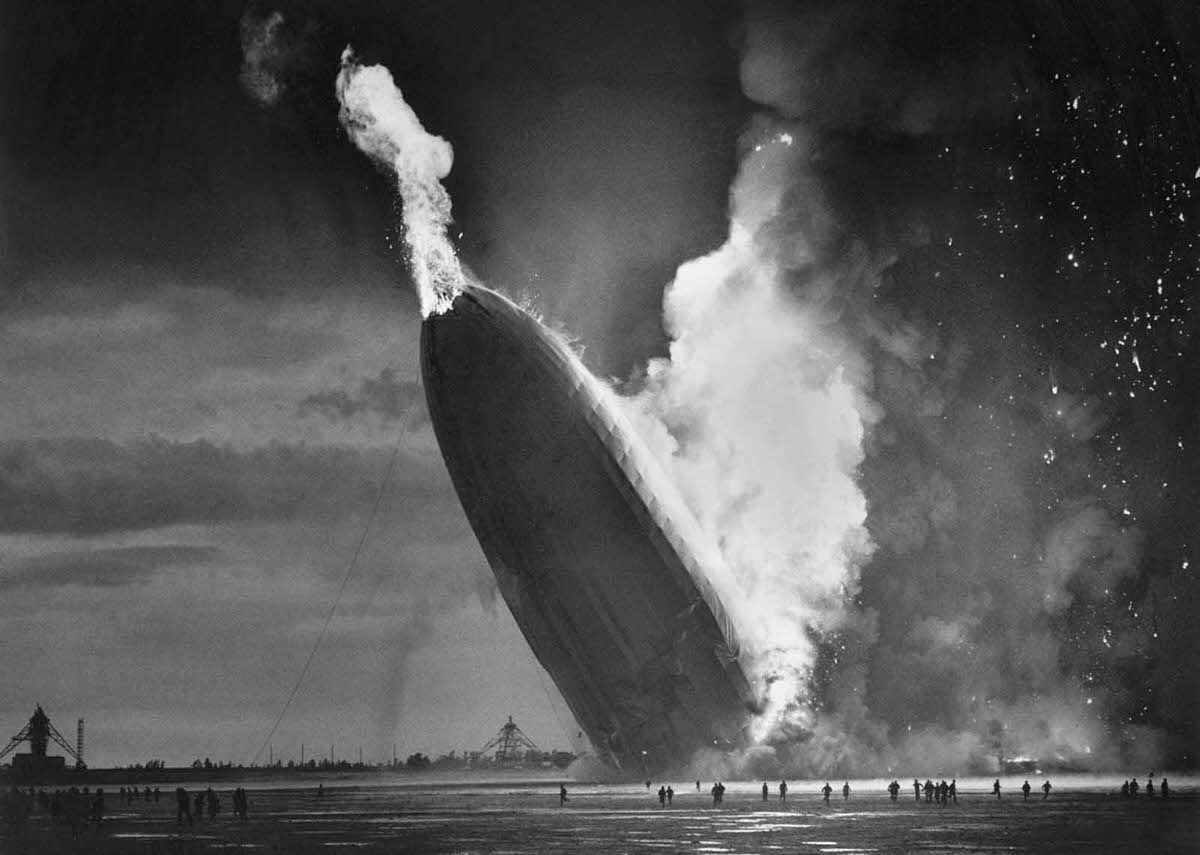
Against a dim sky at the U.S. Naval Station in Lakehurst, New Jersey, the German dirigible Hindenburg tilts sharply downward, its tail engulfed in a roaring column of fire. The airship’s vast hull—once a symbol of modern engineering and glamorous travel—hangs in a steep, catastrophic angle as smoke billows outward and bright sparks scatter into the night. Along the ground, small human silhouettes and equipment frames emphasize the scale of the disaster and the terrifying speed at which the scene is unfolding.
Moments like this fixed the Hindenburg disaster in public memory: a technological marvel turning, in seconds, into flaming ruins. The photograph’s stark contrast—white-hot flame against darkening clouds—draws the eye from the burning tail down the length of the rigid airship, capturing the instant before the structure fully collapses. It is both an aviation history milestone and a sobering record of how quickly confidence in an invention can be shattered.
For readers exploring early flight, airship travel, and the history of inventions, the Hindenburg crash on May 6, 1937 remains a pivotal turning point. The image preserves more than wreckage; it preserves a shift in expectations, when the promise of lighter-than-air passenger service yielded to fear, scrutiny, and a new era of aviation priorities. In that sense, this historical photo stands as a visual boundary marker between the age of the great dirigibles and what came after.