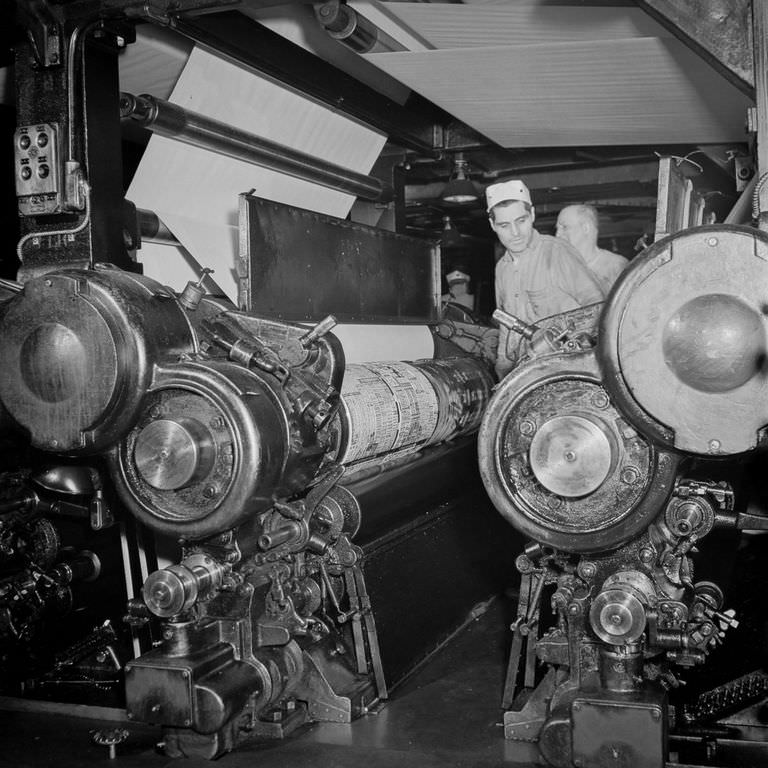
Steel rollers and heavy housings crowd the foreground, their polished curves catching the shop light while a sheet—already dense with text—threads through the press. Two workers lean in from the right, watchful and intent, as if timing and pressure matter as much as ink. Under the title “Freshly cast and numbered plates,” the scene reads like a snapshot of industrial precision at the moment printed matter becomes repeatable, standardized, and ready for circulation.
Behind the machinery is the older craft of plate work: casting, numbering, and keeping sets in order so pages align and editions match. Numbered plates were more than bookkeeping—they were a safeguard against chaos in a busy print room, a way to track wear, swap components, and maintain consistency from run to run. The photograph’s tight composition—gears, levers, cylinders, and paper all in motion—highlights how “inventions” often arrived not as a single breakthrough, but as a chain of refinements that made mass printing reliable.
In an era when news, manuals, catalogs, and public notices depended on speed, presses like this turned ideas into tangible output by the thousand. The workers’ proximity to the moving rollers suggests a world where skill meant listening, watching, and adjusting on the fly, even as mechanization advanced. For readers exploring the history of printing technology, this image offers a vivid reminder that innovation lived in factories and workshops, where freshly prepared plates and disciplined numbering systems helped shape modern communication.