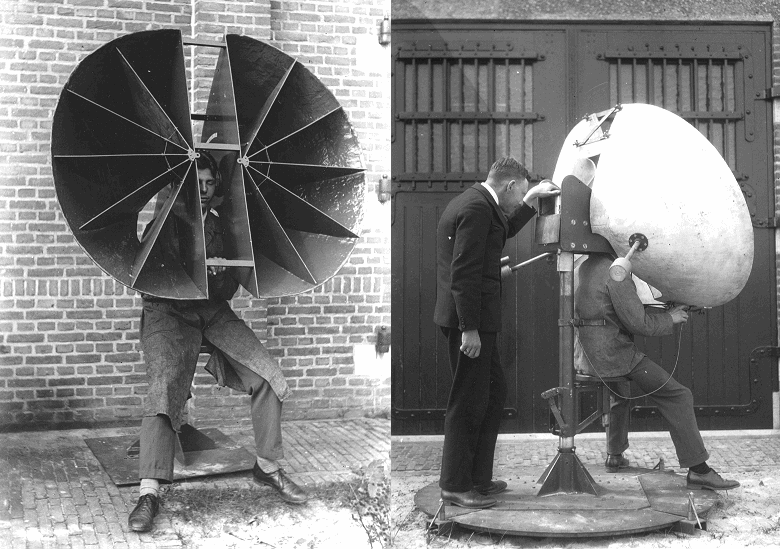
Oddly futuristic for the mid-1930s, the apparatus in this photo looks like a cross between a giant flower and a dish antenna, strapped to a soldier’s body and tested at close range. One view shows a man braced under a circular frame of dark, segmented “petals,” suggesting a collapsible reflector or shield designed to be carried into the field. The brick wall backdrop and the straightforward test stance give the scene a workshop-meets-parade-ground feel—practical experimentation rather than mere display.
Across the second view, the same Dutch device appears in a smoother, bowl-like configuration mounted on a sturdy stand, with two men adjusting it as if calibrating aim, balance, or sightlines. Hinges, braces, and a central mounting point hint at an engineered system meant to be deployed repeatedly, not a one-off prototype. The presence of both a portable version and a fixed mounting suggests the designers were exploring multiple ways to use the same concept, adapting it for different roles within the Engineers Regiment.
Built from 1934 for the Netherlands Army and intended for service connected to the East Indies, the invention invites questions about what problems it was meant to solve—communications, illumination, sound direction, or another specialized field task. Whatever its exact purpose, the photograph documents a moment when military engineering pursued bold, sometimes unconventional forms in pursuit of reliability and advantage. For readers interested in Dutch military technology, interwar inventions, and colonial-era logistics, this image offers a compelling snapshot of experimentation on the eve of major change.