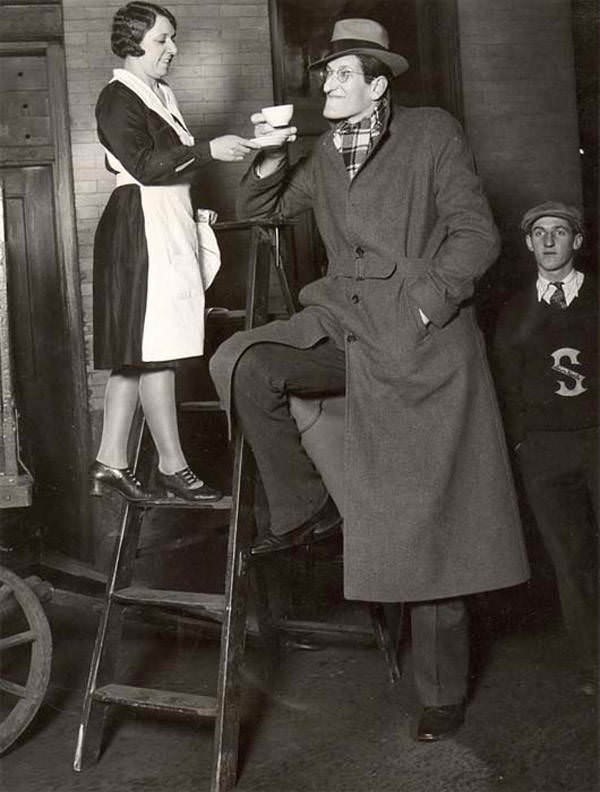
Towering beside the doorway, Jack Earle is dressed in a long overcoat and hat, his height emphasized by the everyday furniture around him. A woman stands on a small step ladder to offer him a cup, turning a simple gesture of hospitality into a striking visual comparison. In the background, another onlooker watches from the shadows, underscoring how quickly a tall figure could become a public spectacle.
The title’s note—7’7” due to acromegalic gigantism—adds a medical lens to what might otherwise be read as novelty. Acromegalic gigantism is linked to excess growth hormone, often leaving not only exceptional stature but also the unmistakable proportions that photographers and audiences of the era fixated on. Seen through that context, the scene becomes more than “weird”: it’s a candid record of how health, appearance, and curiosity intersected in the early 20th century.
Every detail in this 1930 photograph seems arranged to translate scale into storytelling, from the ladder’s rungs to the way the cup sits near his face. The image also hints at the performance of normalcy—sharing a drink, exchanging glances—while the composition quietly insists that Earle’s body is the main subject. For readers searching for Jack Earle, gigantism, acromegaly, or rare medical conditions in historical photos, this post offers a vivid glimpse of how extraordinary height was framed in everyday moments.